
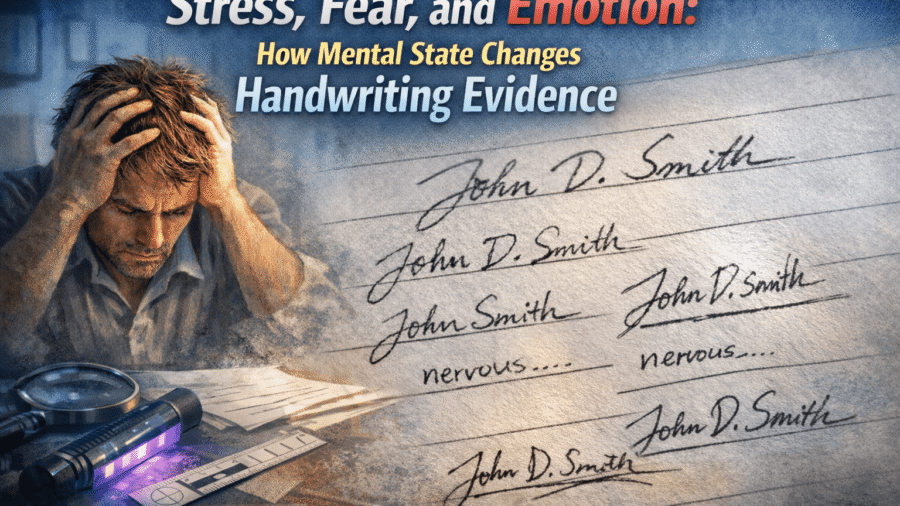
Stress, Fear, and Emotion: How Mental State Changes Handwriting Evidence
Handwriting is often assumed to be a fixed personal characteristic—stable, repetitive, and unique to an individual. In reality, forensic science presents a more nuanced understanding. Handwriting is a complex neuromuscular activity controlled by the brain and influenced by psychological, emotional, and physical conditions. Consequently, stress, fear, and strong emotions can significantly alter handwriting features.
In questioned document examination, recognising these influences is essential. Without proper consideration of mental state, genuine handwriting may appear suspicious, while forensic conclusions may be challenged in court. Therefore, this article examines how emotional conditions affect handwriting and how forensic experts scientifically interpret such variations.
Handwriting as a Neuromuscular Activity
Handwriting is not merely a mechanical action. Instead, it involves cognitive planning, motor coordination, muscle memory, and sensory feedback. Under normal conditions, these processes work in harmony, resulting in fluent and consistent writing.
However, when an individual experiences emotional disturbance, this coordination is disrupted. As a result, visible changes occur in writing rhythm, pressure, speed, and overall control. These changes are especially relevant in forensic examinations involving disputed documents.
Effect of Stress on Handwriting
Stress is one of the most common factors influencing handwriting variation. In forensic contexts, stress may arise during police interrogation, legal disputes, academic pressure, or personal crises.
Typically, stress-affected handwriting may exhibit:
-
Increased writing pressure due to muscular tension
-
Shaky or tremulous strokes
-
Irregular spacing between letters and words
-
Disturbed rhythm and reduced fluency
-
Slower writing speed or abrupt pauses
Importantly, stress does not affect all individuals in the same way. Some writers show increased pressure, while others lose control over fine motor movements. Therefore, forensic examiners evaluate patterns rather than isolated abnormalities.
Fear and High-Stakes Writing Situations
Fear represents a more intense emotional response than general stress. It often appears in high-stakes situations such as signing confessions, disputed wills, or emergency declarations.
During fear-induced writing, the body’s fight-or-flight response becomes dominant. Consequently, fine motor control deteriorates. Handwriting may then display:
-
Excessive pen lifts and broken strokes
-
Distorted letter formations
-
Sudden slant changes
-
Poor control of curves and loops
From a forensic standpoint, such writing can resemble disguised or simulated handwriting. However, the underlying cause is involuntary emotional disturbance rather than conscious manipulation. Hence, contextual analysis becomes crucial.
Influence of Emotional States on Natural Variation
Emotions such as grief, anxiety, depression, anger, or excitement can also influence handwriting. Depending on intensity and duration, these emotions may cause temporary or prolonged changes.
For example:
-
Depression may result in smaller writing size and reduced pressure
-
Anxiety often produces cramped letters and uneven spacing
-
Anger may lead to heavy pressure and sharp angular strokes
These variations fall under the concept of natural variation, which allows genuine handwriting to change without indicating forgery. Accordingly, forensic experts must differentiate natural variation from intentional alteration.
Distinguishing Stress Effects from Forgery
One of the most challenging aspects of questioned document examination is distinguishing emotionally disturbed genuine writing from deliberate forgery or disguise.
To achieve this, examiners apply several scientific principles. For instance, they assess:
-
Consistency of deviations throughout the document
-
Persistence of fundamental writing habits
-
Absence of unnatural hesitations or patching
-
Stroke continuity and natural movement
In contrast, forged writing often shows conscious effort, poor rhythm, and unnatural stroke execution. Therefore, understanding emotional influence helps prevent misinterpretation.
Importance of Contemporaneous Writing Standards
Accurate evaluation of emotionally influenced handwriting depends heavily on contemporaneous standards—known writings produced close in time to the questioned document.
If standard writings are collected under calm conditions, while the questioned writing was produced under emotional stress, direct comparison may be misleading. For this reason, experts prefer multiple standards reflecting similar situational conditions.
Courtroom Significance and Forensic Reporting
Courts frequently encounter documents created under emotional pressure, such as deathbed wills, suicide notes, or confessions. In such cases, forensic opinions must clearly explain the relationship between emotional state and handwriting variation.
A reliable expert report, therefore, includes:
-
Description of the psychological context
-
Scientific explanation of observed deviations
-
Clear distinction between natural variation and forgery
-
Acknowledgement of examination limitations
Such transparency enhances judicial confidence in handwriting evidence.
Conclusion
Stress, fear, and emotion can significantly influence handwriting without altering authorship. Consequently, ignoring mental state may lead to serious forensic errors.
Ultimately, handwriting examination is not about identical letter forms but about understanding human behavior, neuromuscular coordination, and natural variation. By scientifically accounting for emotional influences, forensic experts ensure that genuine writing is correctly interpreted and justice is supported through sound analysis rather than assumption.
