
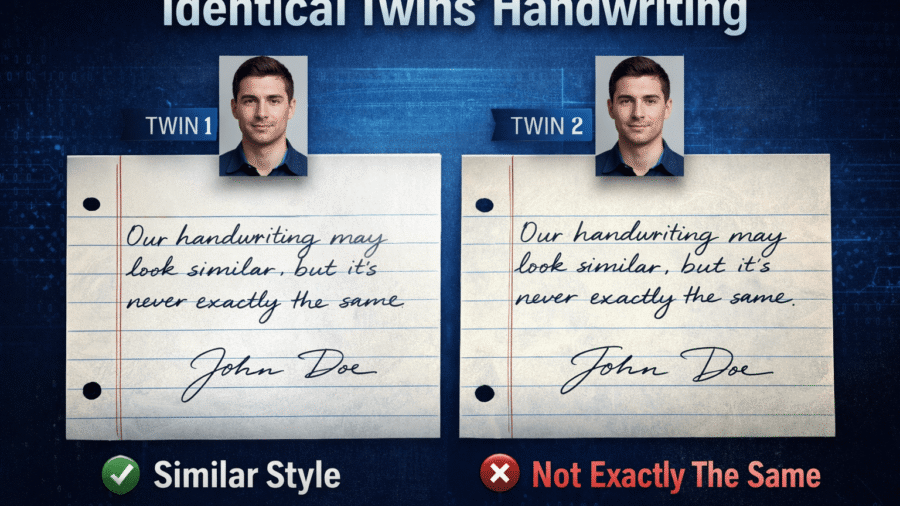
Identical twins' handwriting comparison

Twin Handwriting: Can Identical Twins Have Identical Writing?

Introduction

The concept of twin handwriting often raises an intriguing question: can identical twins have the same handwriting? Since identical twins share the same genetic makeup, many people assume their writing styles must also be identical. However, forensic science reveals a more complex reality.

In fact, forensic handwriting examination shows that while twins may develop similar writing patterns, their handwriting is never completely identical. Therefore, understanding the science behind twin handwriting becomes essential, especially in forensic investigations.

Understanding Twin Handwriting

Twin handwriting refers to the comparison of writing styles between identical or fraternal twins. Because identical twins share similar physical and neurological traits, their handwriting may appear alike at first glance.

However, handwriting is not determined by genetics alone. Instead, it develops through a combination of learning, environment, and individual motor habits. As a result, even identical twins develop subtle but detectable differences in their writing.

Why Twin Handwriting Looks Similar

There are several reasons why twin handwriting may appear similar:

1. Shared Learning Environment

Twins often attend the same schools and learn writing at the same time. Consequently, they receive similar instruction, which influences their writing style.

2. Similar Motor Skills

Because identical twins share genetic traits, their muscle coordination and fine motor skills may be alike. Therefore, their letter formation and writing rhythm can look similar.

3. Practice and Influence

Twins frequently observe and imitate each other. Over time, this mutual influence can lead to similar handwriting characteristics.

Why Twin Handwriting Is Never Identical

Despite these similarities, twin handwriting is never the same. Several factors contribute to these differences:

1. Individual Motor Development

Even minor differences in hand movement and muscle control create unique writing patterns.

2. Personal Habits

Each individual develops unique habits in spacing, pressure, and stroke sequence.

3. Natural Variations

Handwriting naturally varies every time a person writes. Therefore, exact duplication is impossible.

4. Psychological Factors

Mood, stress, and personality traits influence writing behavior. As a result, twins develop distinct writing styles over time.

Forensic Handwriting Examination in Twins

From a forensic perspective, analyzing twin handwriting can be challenging but not impossible. Experts rely on detailed examination techniques to identify differences.

Key Features Examined

  • Letter formation and structure
  • Writing pressure patterns
  • Spacing and alignment
  • Slant and stroke direction
  • Rhythm and writing speed

Even if two samples look similar, forensic experts focus on microscopic and behavioral details to distinguish between them.

Can Twins Copy Each Other’s Handwriting?

Yes, twins can attempt to imitate each other’s handwriting. However, even skilled imitation cannot perfectly replicate natural writing.

When someone copies handwriting, the result often shows signs such as the following:

  • Slow or hesitant strokes
  • Inconsistent pressure
  • Poor rhythm and flow

Therefore, forensic experts can usually detect imitation through detailed analysis.

Real-World Importance in Investigations

Twin handwriting analysis becomes particularly important in legal and criminal cases. For example:

  • Identifying the writer of anonymous notes
  • Verifying signatures in fraud cases
  • Distinguishing between suspects in investigations

In such cases, even small differences can play a crucial role in determining the truth.

Challenges in Twin Handwriting Analysis

High Similarity

The most significant challenge is the strong resemblance between writing styles, which may confuse initial observation.

Limited Samples

If only a few samples are available, distinguishing between twins becomes more difficult.

Intentional Disguise

Sometimes, individuals may intentionally alter their writing, adding complexity to the analysis.

Role of Technology

Modern technology has significantly improved handwriting analysis. Digital tools and AI-based systems help experts examine writing patterns with greater precision.

Additionally, software can analyze stroke patterns, pressure distribution, and writing dynamics. As a result, forensic experts can identify even subtle differences between twin handwriting samples.

Conclusion

Twin handwriting may appear strikingly similar, especially in the case of identical twins. However, no two individuals—even twins—can produce exactly identical handwriting.

Forensic handwriting examination proves that subtle differences always exist, and experts can identify them through detailed analysis. Ultimately, twin handwriting highlights the balance between genetic similarity and individual uniqueness, making it a fascinating subject in forensic science.
ChatGPT Image Mar 27, 2026, 11_51_34 AM

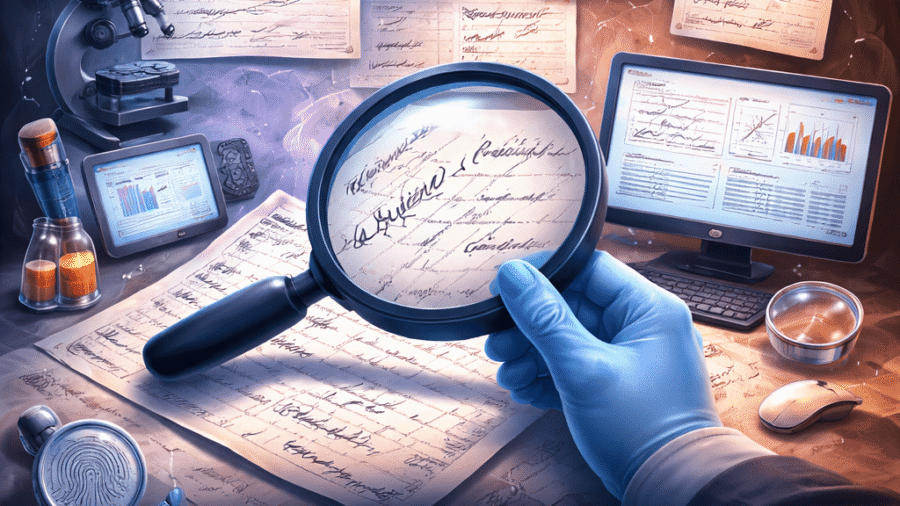
Forensic Handwriting Examination: Detecting Truth in Documents

Forensic Handwriting Examination: Detecting Truth in Documents

In the world of forensic science, documents often hold critical evidence. From legal contracts to handwritten notes, every stroke of a pen can reveal important clues. Forensic handwriting examination plays a vital role in uncovering the truth behind such documents. It helps experts determine authenticity, identify writers, and detect forgery.

Therefore, this field is essential in both criminal investigations and civil disputes.

What is forensic handwriting examination?

Forensic handwriting examination, also known as questioned document examination, involves the scientific analysis of handwriting to verify its authenticity. Experts study various characteristics of writing to determine whether a document is genuine or forged.

In simple terms, it is the process of comparing known handwriting samples with questioned documents to detect similarities or differences.

Key Principles of Handwriting Analysis

Handwriting is considered unique to each individual. However, it is not completely unchangeable. Experts rely on certain principles while conducting handwriting analysis in forensics:

  • Individuality: No two people write the same
  • Natural variation: A person’s handwriting may vary slightly over time
  • Consistency: Genuine writing shows consistent patterns

Thus, examiners look for a combination of similarities and natural variations rather than exact matches.

Techniques Used in Forensic Handwriting Examination

Experts use various scientific techniques to analyze handwriting. Moreover, these methods ensure accuracy and reliability.

1. Visual Examination

Initially, examiners study the document using the naked eye or magnification tools. They analyze:

  • Letter shapes and formations
  • Spacing between words and letters
  • Writing speed and pressure

2. Microscopic Analysis

Additionally, microscopes help identify fine details such as ink flow, pen lifts, and stroke order.

3. Digital Analysis

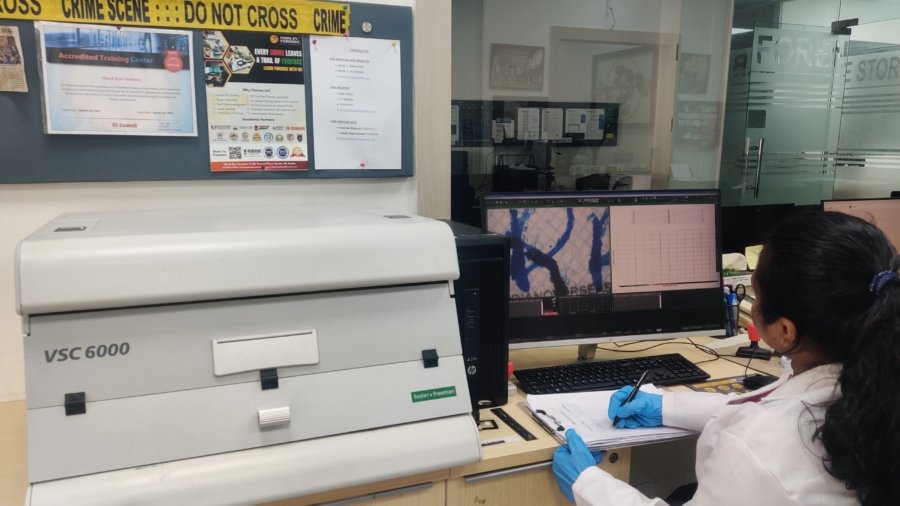
Modern technology allows experts to use software for precise comparisons. Consequently, experts can detect even subtle differences.

4. Signature Verification

Signatures are one of the most commonly examined elements. Therefore, signature verification is crucial in financial and legal fraud cases.

Detecting Forgery in Documents

Forgery is one of the primary concerns in document examination. However, detecting forgery is not always straightforward. There are different types of forgery:

🔹 Simple Forgery

The forger writes a name without trying to imitate the original handwriting.

🔹 Simulated Forgery

The forger attempts to copy someone else’s handwriting or signature.

🔹 Traced Forgery

The original writing is traced to create a duplicate.

In each case, forensic experts analyze inconsistencies such as unnatural pen pressure, slow writing, and tremors. Consequently, these signs help in detecting forgery in documents.

Applications in Real-World Cases

Forensic handwriting examination is widely used in various scenarios. For example:

  • Legal disputes: Verifying wills, contracts, and agreements
  • Financial fraud: Detecting forged signatures on checks or documents
  • Criminal cases: Identifying anonymous letters or threat notes
  • Historical investigations: Authenticating old manuscripts

As a result, this field plays a crucial role in delivering justice.

 Challenges in Handwriting Examination

Despite its importance, forensic handwriting examination comes with challenges. Firstly, handwriting can change due to age, illness, or emotional state. Secondly, skilled forgers may imitate writing convincingly.

  • Limited or poor-quality samples
  • Intentional disguise of handwriting
  • Lack of sufficient comparison material

Nevertheless, trained experts can still reach reliable conclusions using scientific methods.

Importance in Forensic Science

Understanding forensic handwriting examination is essential because it helps uncover hidden truths. Moreover, it provides valuable evidence in courts and investigations.

  • Supports criminal investigations
  • Strengthens legal arguments
  • Helps prevent fraud

Therefore, handwriting analysis remains a powerful tool in forensic science.

Future of Handwriting Examination

With advancements in technology, handwriting analysis is evolving. For instance, we are using artificial intelligence and machine learning to enhance accuracy.

  • AI-based handwriting recognition
  • Digital forensic tools
  • Improved imaging techniques

As a result, the future of handwriting analysis in forensics looks more precise and reliable than ever.

 Conclusion

Forensic handwriting examination is a fascinating and essential branch of forensic science. In conclusion, it helps detect truth in documents by analyzing writing patterns, identifying inconsistencies, and exposing forgery.

Ultimately, whether it is a disputed signature or an anonymous note, handwriting analysis plays a key role in uncovering the truth and ensuring justice.

ChatGPT Image Feb 14, 2026, 10_46_43 AM

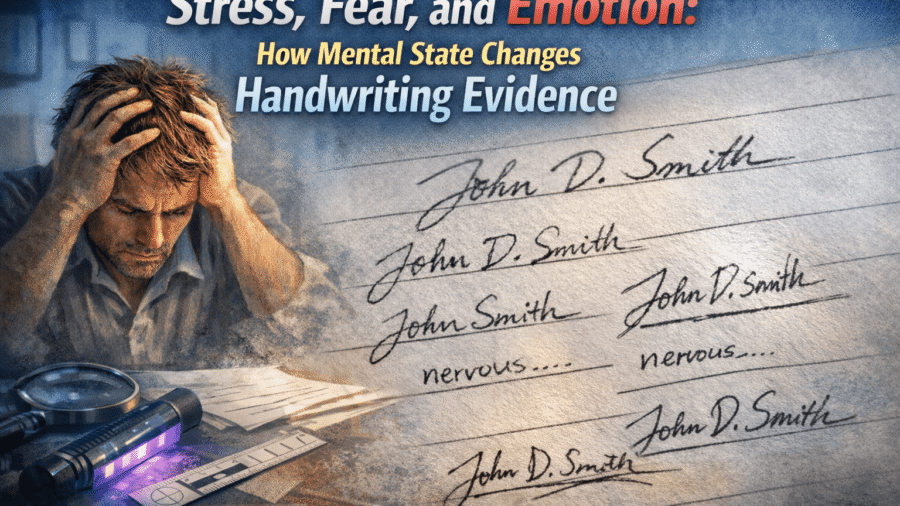
Stress, Fear, and Emotion: How Mental State Changes Handwriting Evidence

Stress, Fear, and Emotion: How Mental State Changes Handwriting Evidence

Handwriting is often assumed to be a fixed personal characteristic—stable, repetitive, and unique to an individual. In reality, forensic science presents a more nuanced understanding. Handwriting is a complex neuromuscular activity controlled by the brain and influenced by psychological, emotional, and physical conditions. Consequently, stress, fear, and strong emotions can significantly alter handwriting features.

In questioned document examination, recognising these influences is essential. Without proper consideration of mental state, genuine handwriting may appear suspicious, while forensic conclusions may be challenged in court. Therefore, this article examines how emotional conditions affect handwriting and how forensic experts scientifically interpret such variations.

Handwriting as a Neuromuscular Activity

Handwriting is not merely a mechanical action. Instead, it involves cognitive planning, motor coordination, muscle memory, and sensory feedback. Under normal conditions, these processes work in harmony, resulting in fluent and consistent writing.

However, when an individual experiences emotional disturbance, this coordination is disrupted. As a result, visible changes occur in writing rhythm, pressure, speed, and overall control. These changes are especially relevant in forensic examinations involving disputed documents.

Effect of Stress on Handwriting

Stress is one of the most common factors influencing handwriting variation. In forensic contexts, stress may arise during police interrogation, legal disputes, academic pressure, or personal crises.

Typically, stress-affected handwriting may exhibit:

  • Increased writing pressure due to muscular tension

  • Shaky or tremulous strokes

  • Irregular spacing between letters and words

  • Disturbed rhythm and reduced fluency

  • Slower writing speed or abrupt pauses

Importantly, stress does not affect all individuals in the same way. Some writers show increased pressure, while others lose control over fine motor movements. Therefore, forensic examiners evaluate patterns rather than isolated abnormalities.

Fear and High-Stakes Writing Situations

Fear represents a more intense emotional response than general stress. It often appears in high-stakes situations such as signing confessions, disputed wills, or emergency declarations.

During fear-induced writing, the body’s fight-or-flight response becomes dominant. Consequently, fine motor control deteriorates. Handwriting may then display:

  • Excessive pen lifts and broken strokes

  • Distorted letter formations

  • Sudden slant changes

  • Poor control of curves and loops

From a forensic standpoint, such writing can resemble disguised or simulated handwriting. However, the underlying cause is involuntary emotional disturbance rather than conscious manipulation. Hence, contextual analysis becomes crucial.

Influence of Emotional States on Natural Variation

Emotions such as grief, anxiety, depression, anger, or excitement can also influence handwriting. Depending on intensity and duration, these emotions may cause temporary or prolonged changes.

For example:

  • Depression may result in smaller writing size and reduced pressure

  • Anxiety often produces cramped letters and uneven spacing

  • Anger may lead to heavy pressure and sharp angular strokes

These variations fall under the concept of natural variation, which allows genuine handwriting to change without indicating forgery. Accordingly, forensic experts must differentiate natural variation from intentional alteration.

Distinguishing Stress Effects from Forgery

One of the most challenging aspects of questioned document examination is distinguishing emotionally disturbed genuine writing from deliberate forgery or disguise.

To achieve this, examiners apply several scientific principles. For instance, they assess:

  • Consistency of deviations throughout the document

  • Persistence of fundamental writing habits

  • Absence of unnatural hesitations or patching

  • Stroke continuity and natural movement

In contrast, forged writing often shows conscious effort, poor rhythm, and unnatural stroke execution. Therefore, understanding emotional influence helps prevent misinterpretation.

Importance of Contemporaneous Writing Standards

Accurate evaluation of emotionally influenced handwriting depends heavily on contemporaneous standards—known writings produced close in time to the questioned document.

If standard writings are collected under calm conditions, while the questioned writing was produced under emotional stress, direct comparison may be misleading. For this reason, experts prefer multiple standards reflecting similar situational conditions.

Courtroom Significance and Forensic Reporting

Courts frequently encounter documents created under emotional pressure, such as deathbed wills, suicide notes, or confessions. In such cases, forensic opinions must clearly explain the relationship between emotional state and handwriting variation.

A reliable expert report, therefore, includes:

  • Description of the psychological context

  • Scientific explanation of observed deviations

  • Clear distinction between natural variation and forgery

  • Acknowledgement of examination limitations

Such transparency enhances judicial confidence in handwriting evidence.

Conclusion

Stress, fear, and emotion can significantly influence handwriting without altering authorship. Consequently, ignoring mental state may lead to serious forensic errors.

Ultimately, handwriting examination is not about identical letter forms but about understanding human behavior, neuromuscular coordination, and natural variation. By scientifically accounting for emotional influences, forensic experts ensure that genuine writing is correctly interpreted and justice is supported through sound analysis rather than assumption.

ChatGPT Image Feb 6, 2026, 10_44_55 AM

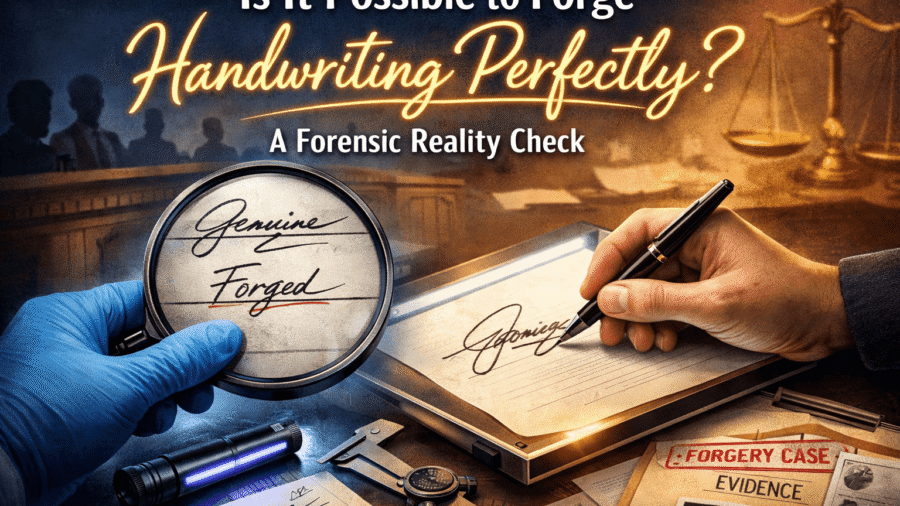
Is It Possible to Forge Handwriting Perfectly? A Forensic Reality Check

Is It Possible to Forge Handwriting Perfectly? A Forensic Reality Check

Handwriting forgery is commonly portrayed as an art that can be perfected with enough practice. Movies and popular crime fiction often show forgers producing signatures so convincing that no one questions their authenticity. This portrayal fuels a widespread belief: if handwriting looks identical, it must be genuine.
From a forensic science perspective, this belief is misleading.

In reality, handwriting forgery is far more complex than copying letter shapes. Forensic handwriting examination consistently demonstrates that a “perfect” forgery is not achievable when scientific analysis is applied.

Understanding Handwriting as a Forensic Trait

Handwriting is not a drawing—it is a neuromuscular activity. Once learned, writing movements become automatic and are controlled subconsciously by the brain. These motor habits develop over years and are influenced by physiology, coordination, and writing rhythm.

Because of this, every individual develops:

  • A unique writing rhythm and speed

  • Habitual stroke sequences

  • Natural pressure variation

  • Consistent spacing and proportions

  • Unconscious movement patterns

In cases of handwriting forgery, a forger may imitate the visible form of letters, but they cannot replicate the genuine writer’s underlying motor behavior. This distinction forms the foundation of forensic handwriting analysis.

Common Methods of Handwriting Forgery

Understanding how handwriting forgery is committed helps explain why it fails under forensic examination.

1. Freehand Simulation

The forger attempts to copy the handwriting by observation and practice. While the result may appear similar, it often shows hesitation, uneven rhythm, and poor line quality.

2. Tracing

The genuine writing is traced directly or indirectly. This method frequently produces blunt starts and stops, tremors, and unnatural pen lifts—classic indicators of forgery.

3. Disguised Writing

In some cases, the original writer deliberately alters their handwriting to deny authorship later. Ironically, disguised writing often becomes more identifiable due to exaggerated or inconsistent features.

None of these methods can fully reproduce the natural variation present in genuine handwriting.

Why Handwriting Forgery Fails Under Forensic Examination

Forensic document examiners do not rely on a single letter or signature. Instead, they conduct a comparative analysis of numerous characteristics, including:

  • Line quality: smooth and fluent vs slow and hesitant

  • Writing rhythm: natural flow vs drawn appearance

  • Pen pressure: consistent variation vs mechanical uniformity

  • Stroke direction and sequence: often incorrect in forged writing

  • Natural variation: present in genuine writing, limited in forgeries

A critical forensic principle is that no two genuine writings are exactly identical, even when written by the same person. Therefore, handwriting that appears overly uniform or “too perfect” can actually indicate handwriting forgery.

Can Practice or Technology Create a Perfect Forgery?

A common assumption is that extensive practice can eliminate differences between genuine and forged handwriting. While practice may improve visual similarity, it cannot override deeply ingrained neuromuscular habits.

Even skilled forgers eventually reveal inconsistencies when examined under magnification and side-by-side comparison. Subtle indicators such as incorrect stroke order, unnatural pen pauses, or inconsistent pressure patterns remain detectable.

Digital tools and artificial intelligence can replicate appearance, but forensic handwriting examination focuses on authorship, not aesthetics. When original documents are available, technological imitation does not replace human motor behavior.

Handwriting Forgery and Legal Scrutiny

In courtroom settings, handwriting evidence is evaluated scientifically. Courts do not expect exact duplication; instead, they assess whether questioned writing shows fundamental agreement or irreconcilable differences when compared with genuine specimens.

Because handwriting forgery is based on conscious imitation rather than subconscious habit, it often collapses under expert testimony and cross-examination. This is why many disputed documents fail to withstand forensic and legal scrutiny.

(Internal link opportunity: questioned document examination techniques or signature forgery analysis)

The Forensic Reality Check

So, is it possible to forge handwriting perfectly?

From a forensic standpoint, no.

A forged document may deceive an untrained observer, but it rarely withstands examination by a trained forensic document examiner. As analysis deepens, the unconscious habits of the genuine writer—and the limitations of the forger—become increasingly visible.

Handwriting forgery is not about copying letters; it is about imitating human motor behavior, and that is where forgery consistently fails.

Conclusion

The idea of a “perfect” handwriting forgery is largely a myth. While surface-level similarity can be achieved, forensic handwriting examination reveals differences that cannot be erased through practice, tracing, or technology.

In forensic science, handwriting speaks beyond appearance. It carries the silent imprint of human behavior—an imprint that is extraordinarily difficult to fake and even harder to conceal.

IMG_20250926_162308

Common Myths About Handwriting Examination

Common Myths About Handwriting Examination

Handwriting examination is one of the most misunderstood areas of forensic science. Popular movies, social media posts, and casual opinions have created several myths that often misrepresent how forensic document examiners actually work. As a result, students, legal professionals, and even the general public may develop unrealistic expectations about handwriting analysis. This blog addresses the most common myths about handwriting examination and explains the scientific reality behind them.

Myth 1: Handwriting Examination Is Just Guesswork

One of the most widespread myths is that handwriting examination is subjective and based on guesswork. In reality, forensic handwriting examination follows a systematic and scientific methodology. Examiners analyze numerous individual characteristics such as letter formation, proportions, spacing, alignment, slant, rhythm, and line quality.

Rather than relying on intuition, experts apply established principles like natural variation, habitual writing patterns, and motor control theory. Conclusions are reached only after careful comparison of questioned and known writings using accepted standards and protocols.

Myth 2: Every Person Has Completely Unique Handwriting

It is often said that no two people can have similar handwriting. While handwriting is highly individual, it is not absolutely unique in the way fingerprints or DNA are. Many people are taught similar writing styles in school, which can result in general similarities.

Forensic examiners do not rely on overall appearance alone. Instead, they focus on combinations of individual characteristics and their consistent repetition. Identification is based on the probability of common authorship, not on the claim of absolute uniqueness.

Myth 3: A Single Letter or Word Is Enough for Identification

Movies often show experts identifying a writer based on one letter or a short word. In real forensic practice, this is rarely possible. Handwriting examination requires adequate quantity and quality of writing.

Short samples may lack sufficient individual characteristics or may be heavily influenced by writing conditions. Therefore, examiners prefer multiple writings containing natural, uninterrupted text before offering any meaningful opinion.

Myth 4: Disguised Handwriting Cannot Be Detected

Many people believe that altering handwriting style makes identification impossible. While disguise can complicate examination, it does not necessarily defeat it. Disguised handwriting often shows signs of unnatural movement, inconsistent letter forms, irregular spacing, slow writing speed, and tremors.

Habitual writing features such as stroke order, proportions, and rhythm tend to reappear unintentionally. Skilled examiners are trained to detect these indicators and differentiate disguise from genuine variation.

Myth 5: Anyone Can Analyze Handwriting After Short Training

Graphology and forensic handwriting examination are frequently confused. Graphology focuses on personality interpretation, whereas forensic handwriting examination deals strictly with author identification and authenticity.

Becoming a forensic document examiner requires formal education, extensive training, supervised casework, and continuous practice. A short course or online certification does not qualify someone to give forensic opinions, especially in legal matters.

Myth 6: Photocopies Are Useless for Handwriting Examination

Although original documents are always preferred, photocopies are not entirely useless. Many handwriting features such as letter design, spacing, alignment, and proportions can still be evaluated from good-quality copies.

However, limitations exist. Line quality, pen pressure, and ink-related features are best assessed on originals. Forensic reports clearly mention such limitations to avoid overstated conclusions.

Myth 7: Handwriting Never Changes Over Time

Handwriting is relatively stable but not completely fixed. Factors such as age, health, writing instruments, writing surface, emotional state, and writing speed can influence handwriting.

Examiners account for these variations by comparing writings from relevant time periods and assessing whether observed differences fall within natural variation or indicate different authorship.

Myth 8: Experts Always Give a Definite Yes or No Opinion

Another misconception is that forensic experts always give absolute conclusions. In reality, opinions may range from identification and elimination to probable, possible, or inconclusive findings.

Scientific integrity requires examiners to acknowledge limitations. An inconclusive opinion does not indicate incompetence; rather, it reflects responsible and ethical practice.

Conclusion

Handwriting examination is a disciplined forensic science grounded in observation, comparison, and evaluation. The myths surrounding it often arise from oversimplification and media portrayal. Understanding the realities of handwriting examination helps students, investigators, and legal professionals appreciate both its strengths and its limitations.

By recognizing these myths, we can better respect the role of forensic document examiners in the justice system and ensure that handwriting evidence is interpreted accurately and responsibly.