Fingerprint analysis tools and techniques

Tools & Equipment Used in Fingerprint Analysis

Fingerprint analysis is one of the most reliable methods of identification in forensic science. However, accurate results depend heavily on the tools and equipment used in fingerprint analysis. From crime scene investigation to laboratory examination, forensic experts rely on specialized instruments to detect, develop, and analyze fingerprints.

Therefore, understanding fingerprint analysis equipment is essential for anyone involved in forensic investigations.

 Importance of Tools in Fingerprint Analysis

The success of tools for latent fingerprint analysis depends on selecting the right method for each situation. For instance, different surfaces and environmental conditions require different tools.

  • Proper tools improve accuracy
  • Moreover, they help preserve delicate evidence
  • Additionally, they enhance the visibility of latent prints

Thus, forensic fingerprint tools play a crucial role in solving criminal cases.

Basic Tools Used in Fingerprint Analysis

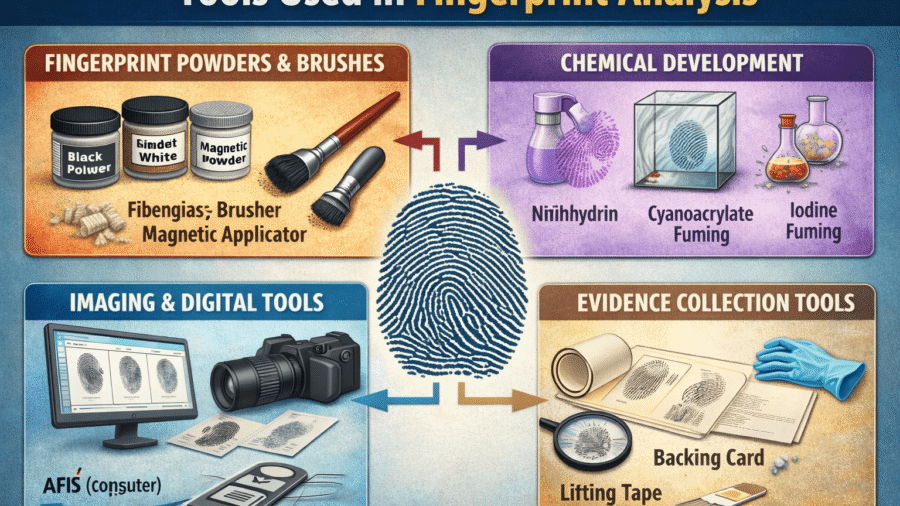
 Fingerprint Powders

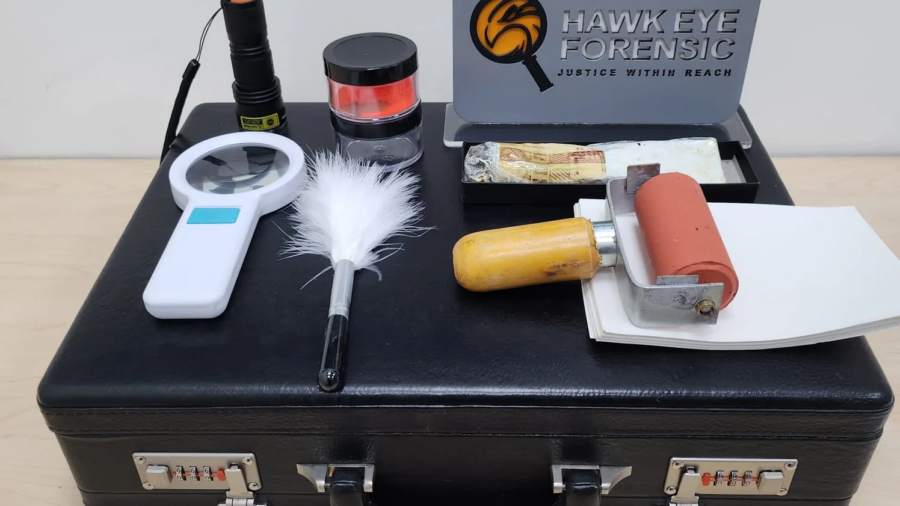
Fingerprint powders are among the most common tools used in fingerprint analysis. They help visualise latent prints on non-porous surfaces.

  • Black powder for light surfaces
  • White or aluminium powder for dark surfaces
  • Magnetic powder for delicate prints

As a result, powders make invisible fingerprints visible.

Brushes for Powder Application

Brushes are used to apply fingerprint powder carefully. However, improper use can damage prints.

  • Fiberglass brushes
  • Feather brushes
  • Magnetic applicators

Therefore, skilled handling is essential to avoid distortion.

 Chemical Equipment for Fingerprint Development

Chemical methods are used when powders are not effective. In particular, they are useful for porous surfaces like paper.

 Ninhydrin

Ninhydrin reacts with amino acids in sweat to produce a purple colour.
Consequently, it is widely used in forensic laboratories.

 Cyanoacrylate (Super Glue Fuming)

This method is used for non-porous surfaces. When heated, the fumes adhere to fingerprint residue, making it visible.

Moreover, this technique is highly effective for plastic, glass, and metal surfaces.

Iodine Fuming

Iodine vapors temporarily develop fingerprints. However, the prints fade quickly, so they must be photographed immediately.

Optical and Imaging Tools

Modern fingerprint analysis relies heavily on optical tools. These tools improve detection and documentation.

Magnifying Glass and Microscopes

  • Help examine fine ridge details
  • Additionally, assist in identifying minute points

 Alternate Light Sources (ALS)

ALS uses different wavelengths of light to reveal hidden prints.
For example, UV light can make latent prints more visible.

 Digital Cameras

High-resolution cameras are used to capture fingerprint images.
Therefore, proper documentation is ensured for court presentation.

Digital Fingerprint Analysis Equipment

Technology has revolutionised fingerprint examination techniques. As a result, digital tools are now widely used.

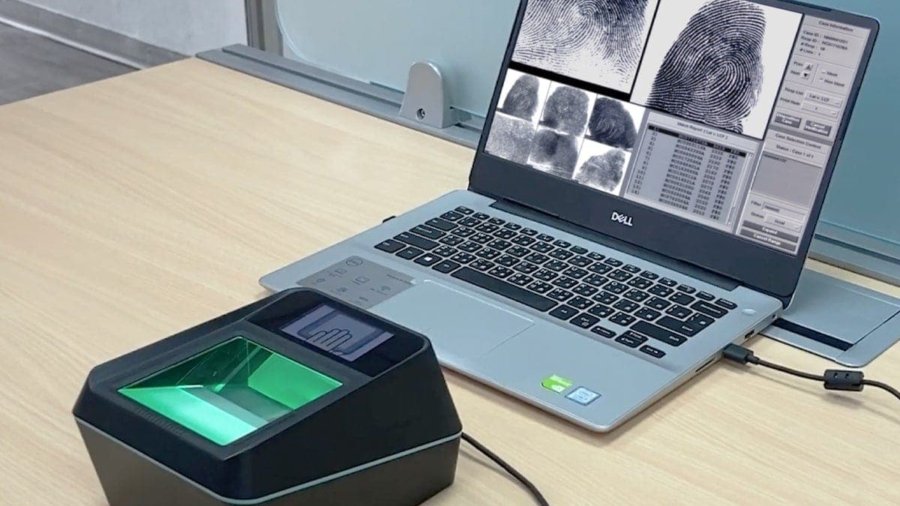
 AFIS (Automated Fingerprint Identification System)

AFIS is a computerised system that matches fingerprints with large databases.

  • Fast comparison of prints
  • Moreover, reduces manual effort
  • High accuracy in identification

 Fingerprint Analysis Software

Advanced software helps enhance and compare prints.

  • Image enhancement
  • Pattern recognition
  • Automated matching

Thus, digital tools improve efficiency and reliability.

 Evidence Collection and Preservation Tools

Collecting fingerprints properly is just as important as analyzing them. Therefore, specialized tools are used for preservation.

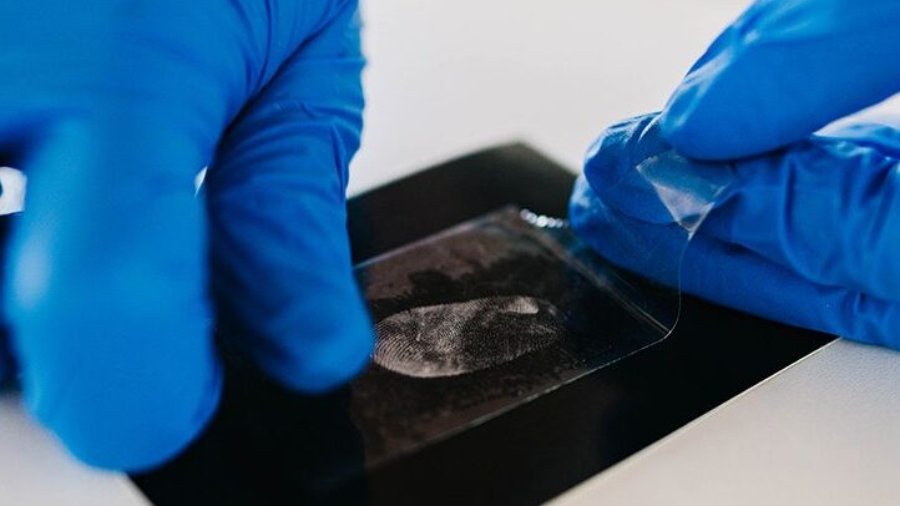
 Lifting Tapes

  • Used to lift developed fingerprints
  • Preserve prints for further analysis

 Backing Cards

  • Provide contrast and support
  • Help in storing lifted prints

 Gloves and Protective Gear

  • Prevent contamination
  • Ensure evidence integrity

Consequently, proper handling ensures reliable results.

Challenges in Using Fingerprint Tools

Despite advanced tools, challenges still exist. For example:

  • Improper tool selection
  • Environmental interference
  • Human error

However, trained professionals can overcome these issues with experience and proper techniques.

 Future of Fingerprint Analysis Equipment

The future of fingerprint analysis equipment is driven by innovation. For instance, AI and machine learning are improving accuracy.

  • AI-based fingerprint recognition
  • Portable scanning devices
  • 3D fingerprint analysis

As a result, forensic investigations are becoming faster and more precise.

Conclusion

Tools and equipment used in fingerprint analysis are essential for accurate identification. From powders and chemicals to advanced digital systems, each tool plays a vital role.

In conclusion, understanding forensic fingerprint tools helps improve analysis, preserve evidence, and ensure justice. As technology advances, fingerprint examination techniques will continue to evolve, making forensic science more reliable than ever.
Causes of fingerprint distortion

Fingerprint Distortion: Causes and Impact on Identification

Fingerprint Distortion: Causes and Impact on Identification

Fingerprint evidence is one of the most reliable forms of identification in forensic science. However, fingerprints are not always perfect when recovered from a crime scene. Often, they appear altered or unclear due to various factors. This phenomenon is known as fingerprint distortion, and it can significantly affect the accuracy of identification.

Therefore, understanding fingerprint distortion is essential for forensic experts performing latent fingerprint analysis.

What is Fingerprint Distortion?

Fingerprint distortion refers to any alteration in the natural ridge pattern of a fingerprint. In simple terms, it occurs when the fingerprint does not accurately reflect the true pattern of the finger.

Moreover, distortion can happen during deposition, development, or even during the analysis process. As a result, it becomes challenging to match prints accurately.

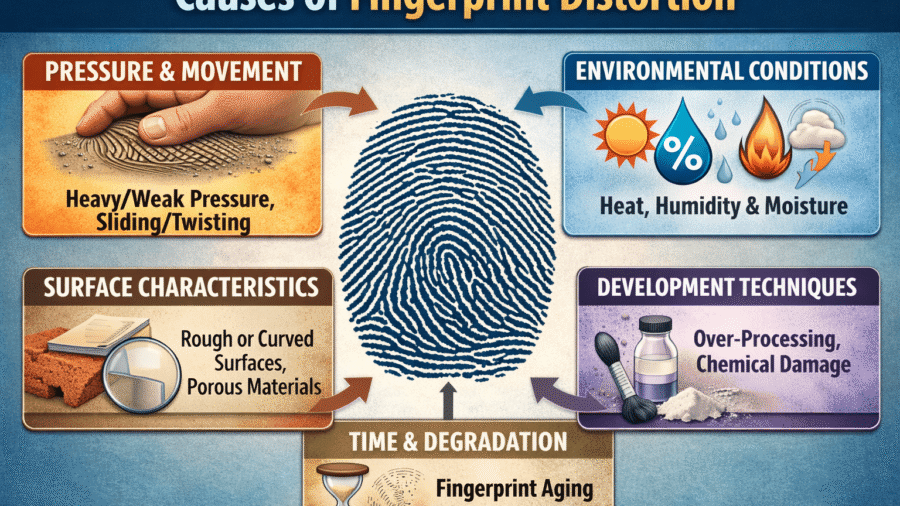
 Causes of Fingerprint Distortion

There are several causes of fingerprint distortion, and they can be broadly categorised into physical, environmental, and procedural factors.

 1. Pressure and Movement During Deposition

One of the most common causes of fingerprint distortion is the way a finger touches a surface. For instance, excessive pressure can flatten the ridges, while insufficient pressure may result in incomplete prints.

  • Heavy pressure causes ridge spreading
  • Light pressure leads to partial prints
  • Movement or sliding creates smudged or stretched patterns

Consequently, such distortions can make comparison more difficult.

 2. Environmental Conditions

Environmental factors also play a significant role. For example, heat, humidity, and moisture can alter fingerprint residue.

  • High temperatures can degrade sweat and oils
  • Humidity may blur ridge details
  • Water exposure can distort or wash away prints

Consequently, forensic experts frequently encounter distorted fingerprints in outdoor or uncontrolled environments.

 3. Surface Characteristics

The type of surface on which a fingerprint is deposited greatly influences distortion. Generally, uneven or textured surfaces create more distortion.

  • Rough surfaces break ridge continuity
  • Curved surfaces stretch the pattern
  • Porous materials absorb residue unevenly

Thus, surface variation directly impacts the clarity of fingerprint evidence.

 4. Time and Degradation

Time is another important factor. Over time, fingerprint residue naturally deteriorates. Additionally, exposure to environmental elements accelerates this process.

  • Older prints lose sharpness
  • Residue becomes faint
  • Details may disappear completely

Therefore, delayed evidence collection increases the chances of distortion.

 5. Improper Development Techniques

Fingerprint development methods can also introduce distortion. For instance, excessive use of powders or chemicals may damage ridge details.

  • Over-brushing can smear prints
  • Incorrect chemical application alters patterns
  • Poor lifting techniques distort the structure

Hence, proper handling is critical in latent fingerprint analysis.

 Impact of Fingerprint Distortion on Identification

The impact of fingerprint distortion on identification is significant. Firstly, distortion can reduce the clarity of ridge details, making comparison difficult. Secondly, it may lead to incorrect interpretations if not handled carefully.

 1. Reduced Accuracy

Distorted fingerprints may not match clearly with known samples. As a result, identification accuracy decreases.

 2. Risk of Misidentification

In extreme cases, distortion can lead to false matches or exclusions. However, trained experts minimize this risk through careful analysis.

 3. Increased Analysis Time

Distorted prints require more time and expertise to analyze. Moreover, examiners must carefully evaluate each feature before concluding.

 4. Limited Evidentiary Value

Severely distorted prints may not be suitable for court presentation. Consequently, they may weaken a case if no other evidence is available.

 Techniques to Overcome Fingerprint Distortion

Despite these challenges, forensic experts use advanced techniques to handle distortion. For example:

  • Digital enhancement tools improve clarity
  • Comparison of multiple features rather than relying on one area
  • Use of alternative light sources to reveal hidden details
  • Advanced imaging software for pattern reconstruction

Therefore, even distorted fingerprints in forensics can still provide valuable evidence.

 Future Advancements in Fingerprint Analysis

Technology is continuously improving fingerprint examination. For instance, artificial intelligence is being used to detect patterns in distorted prints.

  • AI-based matching systems
  • 3D fingerprint analysis
  • Automated enhancement tools

As a result, the gradual reduction of fingerprint distortion’s impact on identification is taking place.

Conclusion

Fingerprint distortion is a common challenge in forensic science. However, proper knowledge and advanced techniques can minimize its impact. Factors such as pressure, environment, surface type, and time all contribute to distortion.

In conclusion, understanding the causes of fingerprint distortion and its effects on identification is essential for accurate forensic analysis. Ultimately, even imperfect fingerprints can reveal the truth when examined carefully.

ChatGPT Image Apr 2, 2026, 11_40_22 AM

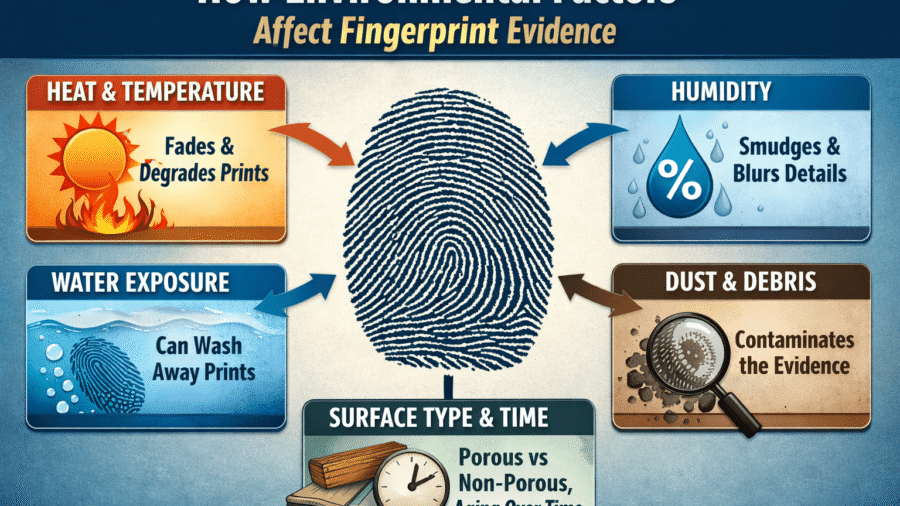
How Environmental Factors Affect Fingerprint Evidence

Fingerprint evidence plays a crucial role in modern forensic science. However, many people assume fingerprints remain unchanged once deposited at a crime scene. In reality, environmental factors affect fingerprint evidence significantly, influencing its visibility, quality, and usability.

Therefore, understanding these factors is essential for accurate latent fingerprint analysis and effective evidence recovery.

1. Temperature: Heat Can Destroy Evidence

Temperature is one of the most critical factors affecting fingerprints. For instance, high heat can cause the sweat and oils in fingerprints to evaporate quickly. As a result, prints may become faint or completely degraded.

  • High temperatures break down organic components
  • Moreover, extreme heat (such as in fire scenes) can destroy evidence entirely
  • In contrast, low temperatures may help preserve prints for longer

Thus, investigators often struggle to recover fingerprint evidence in forensics from heat-exposed environments.

 2. Humidity and Moisture: A Double-Edged Sword

Humidity plays a complex role in fingerprint preservation. On one hand, a small amount of moisture can help retain fingerprint residue. On the other hand, excessive humidity can cause smudging and degradation.

  • High humidity blurs ridge details
  • Additionally, moist environments can spread residue
  • Furthermore, water exposure may distort prints

Consequently, maintaining the right balance of moisture is crucial during evidence collection.

3. Water Exposure: Can Fingerprints Survive?

A common myth is that water destroys fingerprints. However, this claim is not always true. In fact, fingerprints can sometimes survive water exposure depending on the surface.

  • Prints on porous surfaces may still be recoverable after drying
  • Moreover, specialized techniques can reveal hidden prints
  • Even so, prolonged exposure may weaken the evidence

Therefore, advanced latent fingerprint analysis is essential in such cases.

 4. Air and Dust: Silent Contaminators

Airborne particles such as dust and pollutants also affect fingerprint evidence. For example, dust can settle over prints and obscure ridge details. Similarly, continuous air exposure can degrade residue over time.

  • Dust makes prints harder to detect
  • Additionally, airflow can distort prints
  • In outdoor scenes, wind may partially remove evidence

As a result, these factors affecting fingerprints are especially critical in open environments.

 5. Surface Type: The Foundation Matters

The type of surface plays a major role in how environmental factors affect fingerprints. Generally, surfaces are classified as porous and non-porous.

🔹 Non-Porous Surfaces (Glass, Metal, Plastic)

  • Prints remain on the surface
  • However, they are more vulnerable to environmental damage
  • Therefore, they require quick processing

🔹Porous Surfaces (Paper, Wood)

  • Absorb fingerprint residue
  • As a result, they offer better protection
  • However, they require chemical methods for development

Thus, surface type directly impacts the preservation of fingerprint evidence.

6. Time: The Gradual Enemy

Time is another critical factor. Over time, fingerprint residue naturally degrades. Furthermore, environmental exposure accelerates this process.

  • Older prints lose clarity
  • Additionally, prolonged exposure reduces usability
  • Eventually, prints may become undetectable

Therefore, timely evidence collection is essential in forensic investigations.

7. Chemical Exposure: A Hidden Threat

Chemicals such as cleaning agents can significantly affect fingerprints. For instance, household cleaners may partially or completely remove prints. Moreover, some chemicals react with residue, altering its composition.

  • Cleaning agents can destroy evidence
  • Additionally, improper handling may contaminate prints
  • However, in some cases, recovery is still possible

Thus, even chemically exposed fingerprints may still be analyzed using advanced techniques.

Importance in Forensic Investigations

Understanding how environmental factors affect fingerprint evidence is essential. Because of this knowledge, forensic experts can:

  • Choose appropriate development techniques
  • Preserve evidence more effectively
  • Moreover, interpret degraded prints accurately

As a result, modern fingerprint evidence in forensics has become more reliable, even under challenging conditions.

 Conclusion

Fingerprint evidence remains a powerful investigative tool. However, it is not immune to environmental influences. Factors such as temperature, humidity, water, and time all play significant roles.

In conclusion, by understanding these factors affecting fingerprints, forensic professionals can improve the preservation of fingerprint evidence. Ultimately, this leads to more accurate and reliable forensic outcomes.

ChatGPT Image Mar 9, 2026, 02_23_32 PM

How Long Can Fingerprints Remain on Surfaces?

How Long Can Fingerprints Remain on Surfaces?

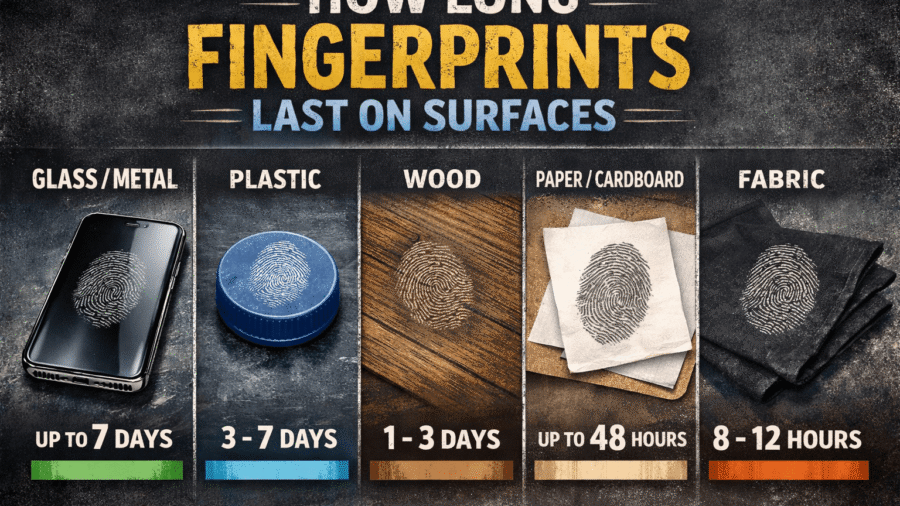
Fingerprints are one of the most important forms of physical evidence used in forensic investigations. They are unique to every individual and can help investigators identify who touched an object or was present at a certain location. However, one question often arises: how long can fingerprints remain on surfaces? The answer depends on several factors, including the type of surface, environmental conditions, and how the object is handled after the fingerprint is left.

What Are Fingerprints Made Of?

Before understanding how long fingerprints last, it is important to know what fingerprints actually consist of. When a person touches a surface, the ridges on their fingertips leave behind tiny traces of substances such as sweat, oils, and natural skin secretions. These substances form what forensic experts call latent fingerprints, which are usually invisible to the naked eye.

The sweat and oils come from glands in the skin. These residues contain water, amino acids, salts, and fatty substances. When these materials transfer onto a surface, they can create a pattern that mirrors the unique ridge structure of the finger.

How Long Fingerprints Can Last

Fingerprints can remain on surfaces for a few hours, several days, or even years, depending on the conditions. In some cases, investigators have successfully recovered fingerprints from objects long after they were touched.

For example, fingerprints have been discovered on items stored for months or even years when the objects were kept in stable environments and not handled frequently. However, in most real-life situations, fingerprints may degrade much sooner due to environmental factors.

The Role of Surface Type

One of the most important factors affecting fingerprint longevity is the type of surface where the print is left. Surfaces can generally be divided into two categories: porous and non-porous.

Non-porous surfaces include materials like glass, metal, plastic, and polished wood. Fingerprints on these surfaces often remain on the outer layer and can be detected more easily using powders or chemical methods. However, these prints can also be removed easily by wiping, touching, or exposure to environmental conditions.

Porous surfaces, such as paper, cardboard, and unfinished wood, absorb the sweat and oils from fingerprints. Because the residue penetrates into the material, fingerprints on porous surfaces can sometimes last longer and be detected using special chemical techniques.

Environmental Factors That Affect Fingerprints

The surrounding environment plays a major role in determining how long fingerprints remain detectable. Several factors can influence fingerprint preservation.

Temperature can cause fingerprint residues to break down over time. High temperatures may speed up the evaporation of sweat and oils, causing fingerprints to fade faster.

Humidity also affects fingerprints. High humidity can cause residues to spread or degrade, while extremely dry conditions may reduce the quality of the print.

Sunlight, especially ultraviolet light, can break down the chemical components of fingerprints. Objects exposed to direct sunlight may lose usable fingerprints more quickly.

Air movement and dust can also interfere with fingerprints. Dust particles may settle on surfaces and cover fingerprint patterns, making them harder to detect.

Handling and Contact

Another important factor is whether the object has been handled after the fingerprint was left. If another person touches the same surface, their fingerprints may overlap or replace the previous ones. Cleaning, wiping, or even casual contact can partially or completely remove earlier fingerprints.

In busy environments where objects are frequently handled, fingerprints may last only a short time. In contrast, objects that remain untouched for long periods can preserve fingerprints much longer.

Forensic Techniques for Detecting Old Fingerprints

Modern forensic science has developed many techniques to detect fingerprints even when they are old or difficult to see. Investigators use different methods depending on the type of surface and the condition of the fingerprint.

Common fingerprint detection methods include:

  • Fingerprint powders, which stick to the oily residues on non-porous surfaces.

  • Chemical reagents, such as ninhydrin, which react with amino acids in fingerprints on porous materials.

  • Cyanoacrylate fuming (super glue method), which creates a visible coating over fingerprint ridges on certain surfaces.

  • Advanced imaging technologies, which can reveal faint or partially degraded prints.

These techniques allow forensic experts to recover fingerprints that might otherwise appear invisible or damaged.

Real-Life Examples in Investigations

In many criminal cases, fingerprints have played a crucial role in identifying suspects long after the crime occurred. Sometimes investigators discover fingerprints on items that were not initially examined but later become important evidence.

However, the ability to recover fingerprints varies greatly from case to case. Some prints disappear quickly, while others remain detectable for extended periods depending on environmental and surface conditions.

Limitations of Fingerprint Evidence

Although fingerprints are highly valuable in forensic science, they are not always guaranteed to remain on a surface. In many situations, fingerprints may be smudged, incomplete, or destroyed by environmental factors. Additionally, some surfaces are not suitable for preserving fingerprints at all.

For this reason, investigators often rely on fingerprints along with other forms of evidence, such as DNA, surveillance footage, and witness statements.

Conclusion

Fingerprints can remain on surfaces for varying lengths of time, ranging from hours to many years. The longevity of a fingerprint depends on several factors, including the type of surface, environmental conditions, and whether the object has been touched or cleaned after the print was left.

While some fingerprints may disappear quickly, others can survive for long periods under the right conditions. Advances in forensic technology have also made it possible to detect older and weaker fingerprints that might have been missed in the past.

Because of their uniqueness and potential longevity, fingerprints continue to be one of the most valuable tools in forensic investigations and personal identification.

WhatsApp Image 2026-03-06 at 09.50.24 (1)

3D Fingerprint Scanning vs Traditional Ink Methods: A Comparative Analysis

Introduction

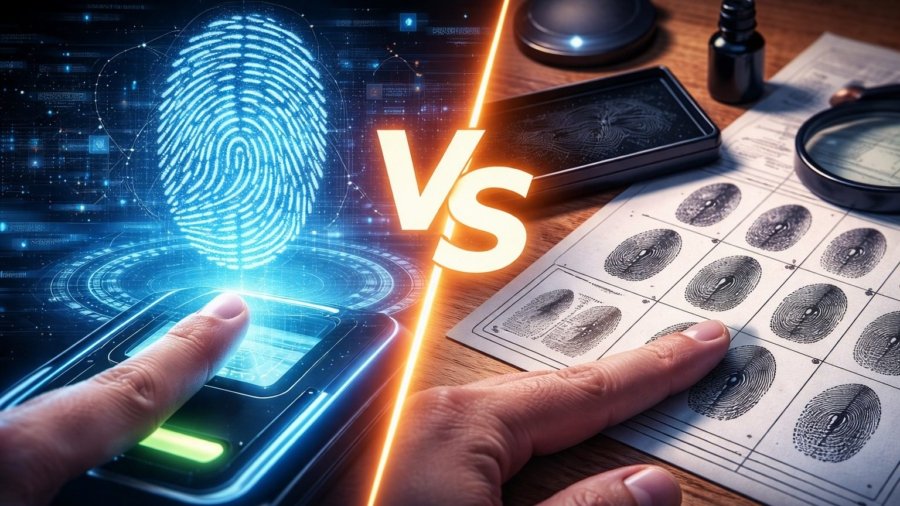
3D fingerprint scanning vs. traditional ink methods is a crucial comparison in modern forensic science. Fingerprint identification has been a cornerstone of forensic investigations for over a century. Traditionally, experts relied on ink-based fingerprint cards to record ridge patterns. However, with rapid technological advancements, 3D fingerprint scanning now offers improved accuracy, efficiency, and digital integration.

Today, fingerprints remain one of the most reliable methods of identification in criminal investigations, border security, and authentication systems. Therefore, understanding the difference between these two techniques is essential for forensic professionals and organizations.

Traditional Ink Fingerprinting in Forensic Science

The traditional ink fingerprinting method emerged in the late 19th century. It gained widespread acceptance after the classification system was introduced by Sir Edward Henry. As a result, fingerprint bureaus were established worldwide.

Even today, law enforcement agencies continue to use this method due to its simplicity and legal acceptance.

How Traditional Ink Fingerprinting Works

The process involves:

  • Applying ink to the fingertip
  • Rolling the finger onto a fingerprint card
  • Preserving the print for analysis

After collection, investigators either examine prints manually or digitize them for systems like the Automated Fingerprint Identification System (AFIS).

Advantages of Traditional Ink Fingerprinting

Traditional ink fingerprinting offers several benefits:

  • ✔ Cost-effective and affordable
  • ✔ Easy to use in remote locations
  • ✔ No advanced equipment required
  • ✔ Widely accepted in courts

Therefore, it remains relevant, especially in low-resource environments.

Limitations of Ink Fingerprint Methods

However, this method has notable drawbacks:

  • ❌ Smudging and distortion risks
  • ❌ Time-consuming process
  • ❌ Requires physical storage
  • ❌ Hygiene concerns with shared ink

Consequently, the accuracy often depends on the examiner’s skill.

What’s 3D Fingerprint Scanning?

In contrast, 3D fingerprint scanning captures the three-dimensional structure of fingerprint ridges instead of flat images. This technology records:

  • Ridge depth
  • Pore structure
  • Subsurface features

As a result, it provides far more detailed and reliable data.

How 3D Fingerprint Scanning Works

3D scanners use advanced technologies such as the following:

  • Optical sensors
  • Ultrasonic imaging
  • Capacitive sensing
  • Structured light

These systems project waves or light onto the finger and generate a 3D digital model. Unlike ink methods, they capture both surface and subsurface details.

Key Differences Between 3D Fingerprint Scanning and Ink Methods

1. Accuracy and Detail

3D fingerprint scanning captures deeper structural details, making it significantly more accurate than ink-based methods.

2. Speed and Efficiency

Ink methods require manual effort and drying time. In contrast, 3D scanners capture data instantly, making them ideal for airports and border security.

3. Digital Integration

Ink prints require physical storage or later digitisation. However, 3D scanning directly integrates with digital databases like AFIS, improving efficiency.

4. Hygiene and User Experience

Ink methods can be messy and unhygienic. On the other hand, 3D scanners offer a clean and contactless experience.

Forensic Implications of 3D Fingerprint Scanning

In forensic investigations, precision is critical. Since crime scene prints are often partial, 3D scanning helps analysts do the following:

  • Improve matching accuracy
  • Reduce human error
  • Speed up investigations

Additionally, automated algorithms enhance objectivity in analysis.

Security Considerations

Although 3D fingerprint scanning improves security, challenges still exist. For example, spoofing using fake fingerprints remains possible.

However, advanced scanners detect the following:

  • Blood flow
  • Skin elasticity

Therefore, they offer stronger protection compared to traditional methods.

Cost and Accessibility

  • Ink Fingerprinting: Low cost, widely accessible
  • 3D Scanning: High initial investment but long-term efficiency

Thus, organizations must balance cost with performance needs.

Future of Fingerprint Identification

The future of 3D fingerprint scanning vs traditional ink methods clearly leans toward digital transformation. Emerging integrations include:

  • Artificial Intelligence (AI)
  • Cloud-based databases
  • Blockchain security
  • Multimodal biometrics

Ultimately, 3D fingerprint scanning is expected to become the global standard.

Conclusion

In conclusion, both methods have their place in forensic science.

Traditional ink fingerprinting offers affordability and legal reliability. However, 3D fingerprint scanning provides superior accuracy, speed, hygiene, and digital integration.

Therefore, while ink methods remain useful in certain contexts, the future of biometric identification is undoubtedly digital.

ChatGPT Image Feb 21, 2026, 10_12_15 AM

Methods of Developing Latent Fingerprints: Powder, Chemical & Optical Techniques

Methods of Developing Latent Fingerprints: Powder, Chemical & Optical Techniques

Latent fingerprints play a vital role in forensic investigations because they often provide direct physical evidence linking a suspect to a crime scene. However, unlike patent fingerprints, latent prints are invisible to the naked eye. Therefore, forensic experts must use scientific methods to develop and visualize these hidden impressions without damaging the evidence. Over the years, several reliable techniques have been developed, broadly classified into powder, chemical, and optical methods. Each technique is chosen based on the surface, environmental conditions, and the nature of the evidence.

Understanding Latent Fingerprints

Latent fingerprints are formed when natural secretions from the skin—such as sweat, oils, and amino acids—are transferred onto a surface. Since these residues are usually colorless, they remain unnoticed until properly developed. Consequently, the success of fingerprint development depends on selecting the correct method and applying it carefully.

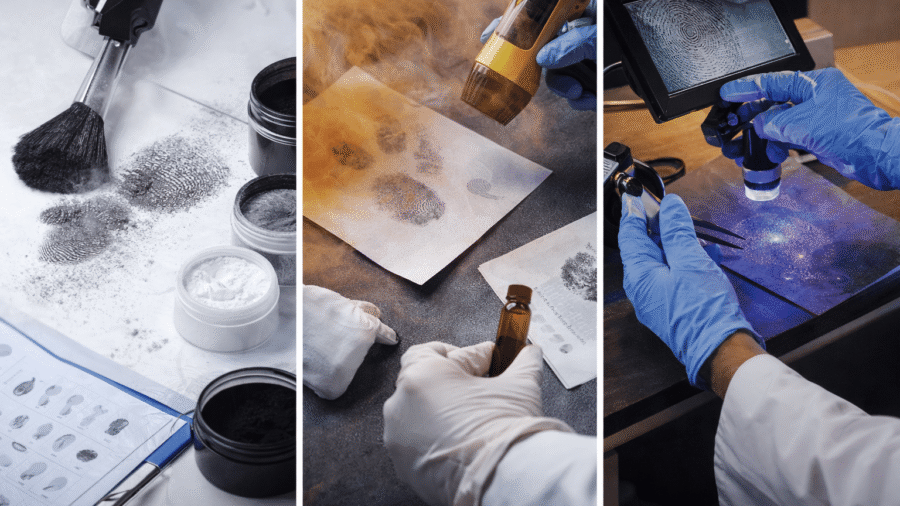
Powder Techniques for Latent Fingerprint Development

Powder methods are among the oldest and most commonly used techniques for developing latent fingerprints. They are simple, cost-effective, and ideal for non-porous surfaces.

How Powder Methods Work

Fingerprint powders adhere to the moisture and oily components present in latent prints. As a result, ridge patterns become visible and can be photographed or lifted.

Types of Fingerprint Powders

  • Black powder: Used on light-colored surfaces such as paper or plastic.

  • White powder: Suitable for dark surfaces like glass or metal.

  • Gray powder: Preferred for multicolored or reflective surfaces.

  • Magnetic powder: Applied using a magnetic applicator, reducing surface damage.

Advantages and Limitations

Powder techniques are quick and easy to apply. Moreover, they work well on smooth surfaces such as glass, mirrors, and polished metals. However, they are not suitable for porous surfaces. Additionally, excessive brushing may damage fragile ridge details, making expert handling essential.

Chemical Techniques for Latent Fingerprint Development

When fingerprints are present on porous or semi-porous surfaces, chemical methods provide better results. These techniques react chemically with fingerprint residues to produce visible impressions.

Ninhydrin Method

Ninhydrin reacts with amino acids in sweat to form a purple or blue-colored compound. Therefore, it is widely used on paper, cardboard, and documents. Since the reaction develops slowly, heat and humidity are often applied to accelerate results.

Iodine Fuming

Iodine fumes temporarily adhere to fatty components of fingerprints, producing a brown image. This method is quick and non-destructive. However, because the prints fade rapidly, immediate photography is required.

Silver Nitrate

Silver nitrate reacts with chloride ions present in sweat, forming silver chloride, which turns dark under light exposure. Consequently, it is useful for old or water-exposed paper evidence. However, it permanently stains the surface and is usually considered a last-resort technique.

Cyanoacrylate (Super Glue) Fuming

Cyanoacrylate vapors polymerize on fingerprint residues, creating a white, stable print. This technique works exceptionally well on non-porous surfaces such as plastics and metals. Moreover, developed prints can be further enhanced using powders or fluorescent dyes.

Optical Techniques for Latent Fingerprint Development

Optical methods rely on light rather than chemicals or powders. These techniques are especially useful when evidence must remain untouched.

Alternate Light Sources (ALS)

Alternate light sources use ultraviolet or blue light to cause fingerprint residues to fluoresce. As a result, prints become visible when viewed through appropriate filters. This method is non-destructive and highly effective on multicolored surfaces.

Laser Illumination

Lasers provide high-intensity light that enhances weak or aged fingerprints. Although highly effective, this technique requires specialized equipment and trained personnel.

Digital Enhancement

Modern forensic laboratories use digital imaging software to enhance faint fingerprints. By adjusting contrast, brightness, and color balance, experts can improve ridge clarity without altering the original evidence.

Choosing the Right Technique

Selecting the appropriate fingerprint development method is crucial. Therefore, forensic examiners consider several factors, including surface type, environmental exposure, age of the print, and case requirements. Often, investigators use multiple techniques sequentially to maximize results. However, improper selection or careless application can permanently destroy valuable evidence.

Importance in Court Proceedings

Developed latent fingerprints often serve as critical evidence in criminal trials. Consequently, courts closely examine the methods used for development. Proper documentation, adherence to standard protocols, and expert interpretation ensure that fingerprint evidence remains admissible and reliable.

Conclusion

Latent fingerprint development is both a scientific and skill-based process. Powder techniques offer simplicity, chemical methods provide depth and permanence, and optical techniques ensure non-destructive visualization. Therefore, understanding these methods is essential for forensic students, investigators, and experts alike. When applied correctly, these techniques transform invisible marks into powerful forensic evidence that can support justice.

ChatGPT Image Feb 19, 2026, 11_39_24 AM

Types of Fingerprints in Forensic Science: Latent, Patent, and Plastic Prints Explained

Types of Fingerprints in Forensic Science: Latent, Patent, and Plastic Prints Explained

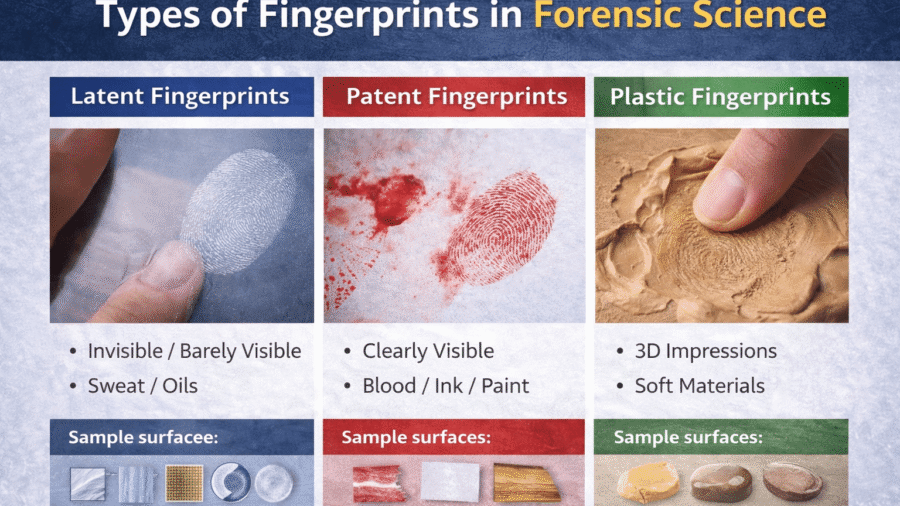
Fingerprint examination plays a crucial role in forensic science because fingerprints provide a reliable method of personal identification. Due to their uniqueness and permanence, investigators widely rely on fingerprints during criminal investigations. However, fingerprints do not always appear in the same form at a crime scene. Instead, their appearance depends on surface type, environmental conditions, and the manner of contact. Therefore, forensic science classifies fingerprints into three main categories: latent, patent, and plastic fingerprints. Understanding these types helps forensic examiners select appropriate collection and development methods.

Importance of Fingerprint Classification

Fingerprint classification holds practical significance in forensic investigations. First, each fingerprint type requires a specific detection and preservation technique. Moreover, incorrect identification can result in evidence loss or contamination. As a result, the evidentiary value of fingerprints may weaken in court. Therefore, forensic examiners must accurately recognize the fingerprint type before applying any development method.

1. Latent Fingerprints

Definition

Latent fingerprints appear invisible or barely visible to the naked eye. These prints form when natural skin secretions, such as sweat and oils, transfer onto a surface. Because offenders usually leave latent fingerprints unintentionally, investigators encounter them most frequently at crime scenes.

Formation

Human skin contains eccrine and sebaceous glands that continuously secrete sweat and oils. When a finger touches a surface, these secretions transfer and create a latent fingerprint. However, since these impressions remain invisible, examiners must apply specialized development techniques to visualize them.

Common Surfaces

Latent fingerprints commonly appear on:

  • Glass

  • Plastic

  • Metal

  • Painted surfaces

  • Paper and cardboard

Development Methods

Forensic experts develop latent fingerprints using physical or chemical methods. For example, fingerprint powders adhere to moisture and oils, making ridge patterns visible. Additionally, chemicals such as ninhydrin, iodine fuming, and cyanoacrylate fuming enhance prints on porous and non-porous surfaces. Therefore, examiners choose development methods based on surface type and environmental conditions.

Forensic Importance

Latent fingerprints often provide critical investigative leads. However, these prints remain fragile and highly susceptible to contamination. Consequently, investigators must handle, package, and document them carefully to preserve their forensic value.

2. Patent Fingerprints

Definition

Patent fingerprints appear clearly visible without enhancement. These prints form when fingers carry a visible substance and transfer it onto a surface.

Formation

Patent fingerprints develop when fingers contact materials such as:

  • Blood

  • Ink

  • Paint

  • Grease

  • Dust

As a result, ridge patterns become immediately visible to the naked eye.

Common Surfaces

Patent fingerprints often appear on:

  • Walls

  • Floors

  • Doors

  • Furniture

  • Paper

Collection Methods

Since patent fingerprints remain visible, investigators do not require chemical development. Instead, they primarily rely on high-quality photography to document the prints. In some cases, investigators may lift the print using adhesive tape. However, photography remains the preferred method because it preserves the original appearance of the print.

Forensic Importance

Patent fingerprints often serve as strong associative evidence, especially when blood or other bodily fluids form the print. Moreover, these prints may directly link a suspect to a criminal act. Nevertheless, improper handling can cause smudging or distortion, which may reduce evidentiary reliability.

3. Plastic Fingerprints

Definition

Plastic fingerprints form three-dimensional impressions when fingers press into soft or malleable surfaces.

Formation

Unlike latent and patent fingerprints, plastic fingerprints result from physical deformation rather than residue transfer. Common materials that capture plastic fingerprints include:

  • Clay

  • Wax

  • Putty

  • Soap

  • Wet paint

Characteristics

Plastic fingerprints often display excellent ridge detail because the surface permanently records the ridge pattern. Consequently, these prints may show clear ridge flow and minutiae.

Collection Methods

Investigators primarily document plastic fingerprints through photography from multiple angles. Additionally, casting techniques may be used in certain cases. Since the impression itself serves as the evidence, examiners must protect it from damage during collection and transportation.

Forensic Importance

Although plastic fingerprints appear less frequently, they provide high evidentiary value due to their clarity. However, environmental exposure and improper handling can easily damage them.

Comparison of Fingerprint Types

Type of Fingerprint Visibility Primary Collection Method
Latent Invisible Chemical or powder development
Patent Visible Photography
Plastic 3D impression Photography and casting

Role of Fingerprints in Court

Fingerprint evidence plays a vital role in judicial proceedings. However, courts carefully assess such evidence based on its quality, collection method, chain of custody, and expert interpretation. Therefore, investigators must follow standard forensic protocols from the crime scene to the courtroom. Any procedural error may weaken the credibility of the evidence.

Conclusion

Latent, patent, and plastic fingerprints each contribute uniquely to forensic investigations. While latent fingerprints appear most frequently, patent and plastic fingerprints often provide clearer ridge details. Therefore, forensic examiners must correctly identify fingerprint types and apply appropriate techniques. Through proper training, scientific methodology, and careful handling, fingerprint evidence continues to remain one of the most powerful tools in forensic science.

64d9ff53329dc344b759856a_Automated Fingerprint Identification System (AFIS)-An Overview

Limitations of Fingerprint Technology in Modern Forensics

Limitations of Fingerprint Technology in Modern Forensics

Introduction

Fingerprint technology limitations have become a critical concern in modern forensic science. Although fingerprint examination has long served as a cornerstone of forensic identification, experts now closely examine its accuracy, reliability, and scientific validity. As forensic methods advance and courts demand stronger validation, professionals must understand the limitations of fingerprint technology in modern forensics to ensure reliable interpretation and judicial acceptance.

Fingerprint Technology Limitations Due to Poor Print Quality

One of the most significant fingerprint technology limitations arises from poor fingerprint quality. At crime scenes, investigators often recover fingerprints that appear partial, smudged, distorted, or overlapped. These conditions obscure ridge details and reduce clarity.

Environmental factors such as heat, moisture, dust, and surface texture further degrade fingerprint impressions. Consequently, low-quality fingerprints often fail to provide sufficient ridge characteristics for reliable comparison, which directly reduces their evidentiary value.

Partial and Fragmentary Prints as a Major Limitation

In practical investigations, forensic experts rarely recover complete fingerprints. Instead, they usually analyze partial or fragmentary impressions. Although Automated Fingerprint Identification Systems (AFIS) assist in searching large databases, partial prints significantly reduce matching accuracy.

Limited ridge detail forces examiners to rely more heavily on interpretation. As a result, false exclusions or inconclusive opinions become more likely, especially when examiners work with minimal ridge information.

Examiner Subjectivity as a Fingerprint Technology Limitation

Fingerprint analysis relies on scientific principles; however, human interpretation remains unavoidable. Examiners evaluate ridge flow, minutiae, and overall pattern consistency. Despite this structured approach, forensic systems lack a universally accepted numerical standard for declaring a fingerprint match.

Cognitive bias and examiner expectations may influence conclusions. Even when experts apply the ACE-V methodology (Analysis, Comparison, Evaluation, and Verification), subjective judgment still plays a role. Therefore, examiner subjectivity remains a persistent fingerprint technology limitation.

👉 Outbound authority link suggestion:
International forensic standards published by organizations such as the Forensic Science Regulator (UK) emphasize the need to address examiner bias in fingerprint analysis.

Limitations of AFIS in Modern Fingerprint Examination

AFIS has improved fingerprint comparison by enabling rapid searches across extensive databases. However, AFIS does not independently establish identity. Instead, it generates potential matches that require manual verification by trained fingerprint examiners.

AFIS performance depends heavily on database quality, algorithm efficiency, and image clarity. Poor input quality or improper encoding often produces missed matches or false candidates. Therefore, overreliance on AFIS without expert validation represents another major fingerprint technology limitation.

Contamination and Secondary Transfer Risks

Fingerprint evidence remains highly vulnerable to contamination. Improper crime scene handling, multiple responders, or inadequate protective measures often introduce extraneous fingerprints. Additionally, secondary transfer occurs when fingerprints move unintentionally through objects or intermediary surfaces.

As a result, the presence of a fingerprint alone does not confirm direct involvement in a crime. This limitation highlights the importance of contextual interpretation alongside fingerprint findings.

Aging and Persistence Issues in Fingerprint Evidence

Experts often describe fingerprints as permanent identifiers, yet fingerprints do not persist indefinitely on surfaces. Environmental exposure, surface handling, and cleaning activities gradually degrade fingerprint impressions.

Moreover, forensic science cannot reliably determine the age of a fingerprint. Investigators cannot establish when a person deposited a print, which limits the usefulness of fingerprint evidence in reconstructing crime timelines.

Courtroom Challenges Linked to Fingerprint Technology Limitations

Modern courts evaluate forensic evidence under strict admissibility standards. Judges demand transparency, disclosure of error rates, and strong scientific validation.

Although courts generally accept fingerprint evidence, defense teams frequently challenge examiner bias, the lack of statistical probability, and limited error quantification. Consequently, fingerprint evidence alone may not support a conviction without corroborative forensic findings.

Why Fingerprints Cannot Replace Other Forensic Techniques

Fingerprint technology primarily establishes identity but does not provide biological, chemical, or temporal information. Unlike DNA analysis, fingerprint examination cannot reveal genetic relationships or biological traits.

Therefore, investigators must integrate fingerprint analysis with other forensic disciplines such as DNA profiling, digital forensics, and trace evidence examination. This dependency prevents fingerprints from functioning as a standalone forensic solution.

Conclusion

Fingerprint technology limitations play a crucial role in shaping modern forensic practice. Issues related to print quality, examiner subjectivity, AFIS constraints, contamination risks, and legal scrutiny restrict the reliability of fingerprint evidence when investigators use it in isolation.

Therefore, forensic professionals must apply fingerprint technology cautiously, scientifically, and ethically. When investigators combine fingerprint examination with proper crime scene management, validated methodologies, and supporting forensic evidence, it continues to serve as a valuable tool in the pursuit of justice.

OG-image-fingerptint-lab

How Do Forensic Experts Collect Fingerprints Without Contamination?

How Do Forensic Experts Collect Fingerprints Without Contamination?

Forensic experts rely on fingerprint evidence because even a single ridge detail can connect a suspect to a crime scene. However, fingerprints remain extremely fragile. Small mistakes during handling or collection can contaminate or destroy them. Therefore, forensic professionals follow strict scientific protocols to collect fingerprints without contamination and preserve their evidentiary value.

What Does Contamination Mean in Fingerprint Evidence?

Contamination occurs when unwanted fingerprints, smudges, or residues transfer onto evidence. Investigators often cause contamination by touching surfaces without gloves, using incorrect tools, or packaging evidence improperly. Such errors can mislead investigations and weaken court testimony. Hence, forensic experts prioritize contamination prevention at every stage.

Securing the Crime Scene

Forensic teams secure the crime scene before starting fingerprint collection. They control entry and exit points and restrict unnecessary movement. Investigators also define clear working paths to avoid accidental contact with evidentiary surfaces. By limiting access, they significantly reduce the risk of fingerprint contamination.

Wearing Personal Protective Equipment (PPE)

Forensic experts wear gloves, masks, shoe covers, and protective clothing at all times. They change gloves frequently, especially after handling different objects. This practice prevents the transfer of skin oils, sweat, or the examiner’s own fingerprints onto evidence. PPE also protects fingerprints from environmental and biological contamination

Conducting Visual Examination First

Experts visually inspect surfaces before touching them. They use oblique lighting, magnifiers, or alternate light sources to locate latent fingerprints. Investigators avoid direct contact until they identify potential ridge detail areas. This careful approach protects fragile fingerprints from smearing or destruction.

Choosing the Right Fingerprint Development Method

Different surfaces demand different fingerprint development techniques. Forensic experts select methods based on surface type and condition.

  • Experts use powder dusting on non-porous surfaces like glass and metal.
  • They apply ninhydrin to porous materials such as paper.
  • They use cyanoacrylate fuming to stabilize fingerprints on non-porous items.

By selecting the correct technique, experts reduce unnecessary handling and prevent contamination.

Handling Evidence Carefully

Experts handle objects from areas unlikely to contain fingerprints, such as edges or rough surfaces. They use forceps and evidence-handling tools instead of bare hands. Investigators also limit repeated processing because excessive handling increases contamination risks.

Lifting Fingerprints Properly

After developing fingerprints, experts lift them using clean lifting tape, gel lifters, or high-resolution photography. They lift one fingerprint at a time and discard lifting materials after single use. This method prevents cross-contamination between impressions.

Documenting and Labeling Evidence

Forensic experts document every step of fingerprint collection. They photograph fingerprints before and after development and record detailed notes. Each lift includes the date, time, location, surface type, and collector’s name. Accurate documentation ensures traceability and strengthens courtroom credibility.

Packaging and Sealing Evidence Correctly

Experts package fingerprint evidence in clean paper envelopes or approved evidence containers. They avoid plastic packaging when moisture could damage prints. Investigators seal, label, and sign each package to maintain evidence integrity.

Maintaining the Chain of Custody

Forensic professionals record every transfer of fingerprint evidence. The chain of custody documents who handled the evidence and when. By maintaining continuous documentation, experts eliminate doubts about contamination or tampering.

Conclusion

Forensic experts prevent fingerprint contamination through discipline, precision, and strict adherence to protocols. From securing the crime scene to proper documentation and packaging, each step protects fingerprint integrity. When experts follow these procedures, fingerprint evidence remains reliable, scientifically valid, and legally admissible.

Fingerprint examination, when handled correctly, continues to serve as one of the strongest tools in forensic science.

WhatsApp-Image-2023-12-12-at-11.53.41-AM

Fingerprint Examination Kit: Essential Tools for Forensic Identification

Fingerprint Examination Kit: Essential Tools for Forensic Identification

Fingerprint examination is one of the most trusted methods of personal identification in forensic science. From crime scene investigation to courtroom testimony, fingerprints provide strong physical evidence linking individuals to objects or locations. Behind every successful fingerprint analysis lies a well-equipped fingerprint examination kit, used by trained forensic professionals.

This blog explains what a fingerprint examination kit is, its key components, and its significance in forensic investigations.

What Is a Fingerprint Examination Kit?

A fingerprint examination kit is a specialized set of tools used to detect, develop, record, preserve, and analyze fingerprints. These kits are used both at crime scenes and in forensic laboratories to ensure that fingerprint evidence is collected accurately and remains legally admissible.

Unlike casual fingerprint collection, forensic examination follows standardized protocols to avoid contamination and misinterpretation.

Importance of a Fingerprint Examination Kit

Most fingerprints recovered during investigations are latent fingerprints, which are invisible to the naked eye. Without proper tools, these prints can be easily damaged or lost.

A fingerprint examination kit helps forensic experts to:

  • Reveal latent fingerprints clearly

  • Preserve ridge details without distortion

  • Maintain proper documentation and chain of custody

  • Support reliable comparison and identification

Major Components of a Fingerprint Examination Kit

1. Personal Protective Equipment (PPE)

Used to prevent contamination of evidence.

Includes:

  • Nitrile or latex gloves

  • Face masks

  • Disposable shoe covers

Forensic significance: Protects fingerprints from contamination by the examiner.

2. Fingerprint Development Tools

a) Fingerprint Powders

Fingerprint powders are commonly used to develop latent prints on non-porous surfaces.

Types of powders:

  • Black powder

  • White powder

  • Grey powder

  • Magnetic powder

Brushes:

  • Fiberglass brush

  • Camel hair brush

  • Magnetic applicator

Suitable surfaces: Glass, plastic, metal, polished wood.

3. Chemical Reagents

Used mainly for porous surfaces.

  • Ninhydrin (paper, cardboard)

  • Iodine fuming (temporary development)

  • Silver nitrate (limited use)

Forensic significance: Reacts with fingerprint residues to make ridge patterns visible.

4. Fingerprint Lifting Materials

Once developed, fingerprints must be preserved.

  • Transparent lifting tape

  • Rubber lifters

  • Gel lifters for textured surfaces

Backing cards: Black or white contrast cards for clarity.

5. Inked Fingerprint Recording Tools

Used for collecting known or control fingerprints.

  • Ink pads or ink slab

  • Roller

  • Ten-print fingerprint cards

  • Cleaning wipes

6. Documentation and Measurement Tools

Accurate documentation is critical for court acceptance.

  • Evidence markers

  • Measurement scales

  • Permanent markers

  • Evidence labels and seals

7. Photography Equipment

Fingerprints must be photographed before lifting.

  • DSLR or forensic camera

  • Macro lens

  • Oblique lighting source

  • Tripod

Standard sequence: Photograph → Develop → Photograph → Lift → Label

8. Advanced Examination Tools (Optional)

Used by trained forensic professionals.

  • Alternate Light Source (UV/blue light)

  • Cyanoacrylate fuming chamber

  • Digital fingerprint scanners

Types of Fingerprint Examination Kits

  • Basic kit: Powders, brushes, lifting tapes

  • Professional forensic kit: Includes chemicals, ALS, and photography tools

  • Educational kit: Used for training forensic students

Role of Fingerprint Examination Kits in Court

The reliability of fingerprint evidence depends on:

  • Proper examination tools

  • Correct methodology

  • Clear documentation

  • Unbroken chain of custody

A standardized fingerprint examination kit strengthens the credibility of forensic testimony and helps evidence withstand legal scrutiny.

Conclusion

A fingerprint examination kit plays a vital role in transforming invisible ridge impressions into meaningful forensic evidence. When used correctly, these tools help establish identity, support investigations, and assist the justice system. For forensic students and professionals alike, understanding the components and use of a fingerprint examination kit is fundamental to effective fingerprint analysis.