ChatGPT Image Apr 7, 2026, 11_41_57 AM

Deepfake Documents: The Next Big Threat in Document Fraud

Introduction

Recently, deepfake documents have become a major concern in document fraud. While deepfake technology first gained attention through videos and images, it now targets digital documents with alarming precision. As a result, detecting fraudulent content has become more difficult for individuals and organizations.

Moreover, professionals in digital forensics must adapt quickly to these evolving threats. You can also explore Digital Forensics Basics (/digital-forensics-basics) to understand the foundation of such investigations.

What Are Deepfake Documents in Document Fraud?

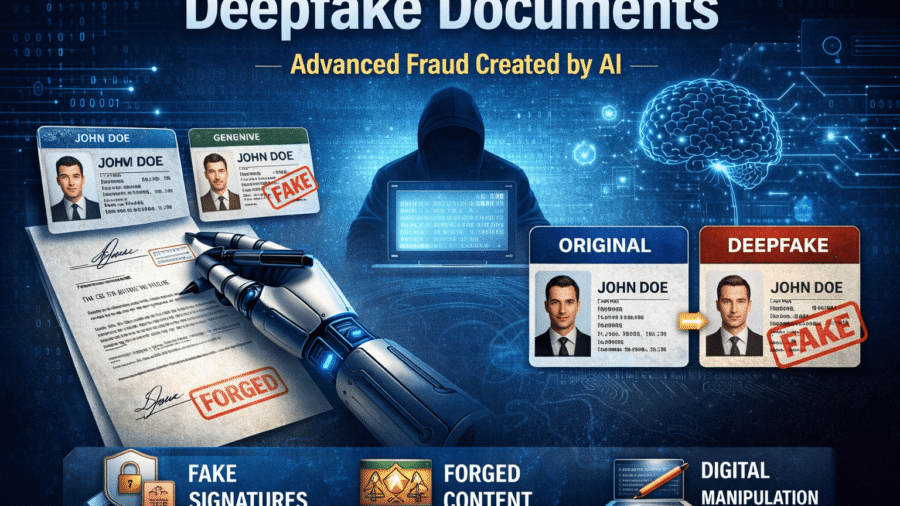
Deepfake documents are AI-generated or digitally manipulated files designed to appear authentic. Unlike traditional forgery, these documents replicate formatting, signatures, and layouts with high accuracy.

In addition, attackers often use machine learning models to study real documents before creating fake versions. Therefore, these documents can easily bypass basic verification systems.

How AI Creates Fake Documents

Artificial intelligence plays a key role in generating fraudulent documents. Typically, attackers follow a structured process:

  • Collect genuine document samples
  • Train AI models on fonts, structure, and signatures
  • Generate realistic replicas with altered information

Furthermore, modern tools can even simulate handwriting and official seals. As a result, the final document appears highly convincing.

Why Deepfake-Based Document Fraud Is Dangerous

High Realism and Accuracy

Deepfake-based documents closely resemble genuine ones. Therefore, even trained professionals may struggle to identify them without advanced tools.

Scalable Fraud Operations

Attackers can quickly produce multiple fake documents. Consequently, fraud becomes more widespread and harder to control.

Bypassing Traditional Verification

Many systems rely on visual checks. However, AI-generated documents can bypass these checks due to their precision.

Serious Financial and Legal Risks

Fraudulent documents can cause financial losses and legal complications. As a result, organizations must take preventive measures seriously.

Deepfake Documents vs Traditional Forgery

Traditional forgery involves manual alterations, which often leave visible traces. In contrast, deepfake documents use automation and AI, making them more sophisticated.

Additionally, traditional methods require time and effort, whereas AI tools enable rapid document creation. Therefore, the scale of fraud increases significantly.

Detection of Deepfake Documents in Digital Forensics

Digital forensics plays a vital role in identifying suspicious documents. Experts use multiple techniques to detect manipulation.

Metadata Analysis

Investigators examine file details such as timestamps and editing history. Any inconsistency may indicate tampering.

Formatting and Layout Review

Even advanced AI may produce small alignment or spacing errors. Experts carefully analyze these elements.

Pixel-Level Examination

Forensic tools detect irregularities at the pixel level. These hidden signs often reveal manipulation.

AI-Based Detection Tools

Interestingly, AI also helps detect fraudulent documents. Machine learning models identify patterns that humans may overlook.

For more profound insights, you can explore:

  • National Institute of Justice
  • Interpol Digital Crime Resources

Prevention Strategies Against AI Document Fraud

Organizations must adopt strong preventive measures to reduce risk.

  • Use secure digital signature systems
  • Implement multi-factor authentication
  • Train employees to identify suspicious documents
  • Conduct regular security audits

Additionally, understanding cybercrime investigation techniques (/cybercrime-investigation-techniques) can help strengthen your defence strategies.

Applications and Impact

Deepfake documents affect multiple sectors, including:

  • Banking and finance
  • Legal systems
  • Corporate businesses
  • Government documentation

Therefore, addressing this issue is essential across industries.

Conclusion

Deepfake documents represent a new and evolving challenge in document fraud. Their ability to mimic real documents with high accuracy makes them a powerful tool for cybercriminals.

However, with advanced forensic techniques and proper awareness, organizations can detect and prevent such threats. Ultimately, staying informed and adopting modern security measures is the key to protecting document integrity.
ChatGPT Image Mar 31, 2026, 10_58_41 AM

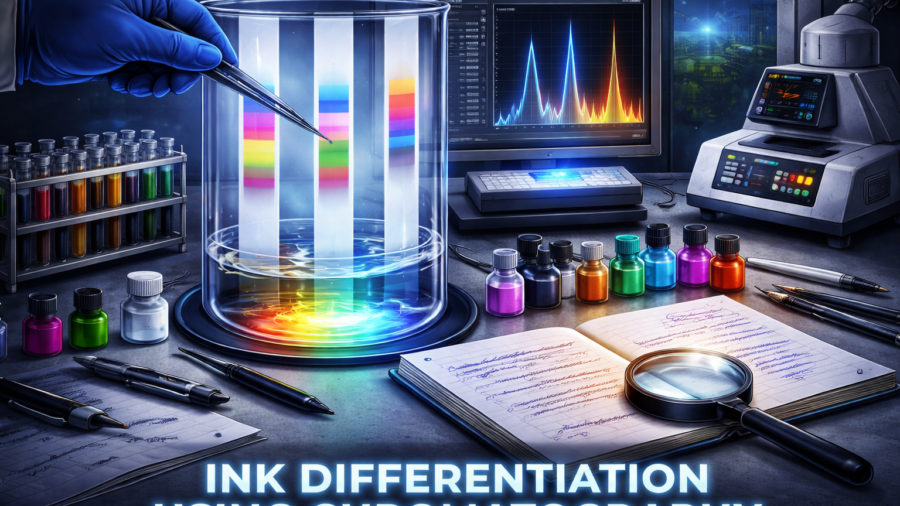
Ink Differentiation Using Chromatography Techniques in Forensic Document Examination

Introduction

In forensic document examination, identifying whether a document has been altered is crucial. One of the most effective methods used for this purpose is ink differentiation. In particular, chromatography techniques allow experts to analyze and compare inks used in questioned documents.

As document fraud increases, these scientific methods have become essential tools for forensic investigators to ensure authenticity and detect tampering.

What is Ink Differentiation?

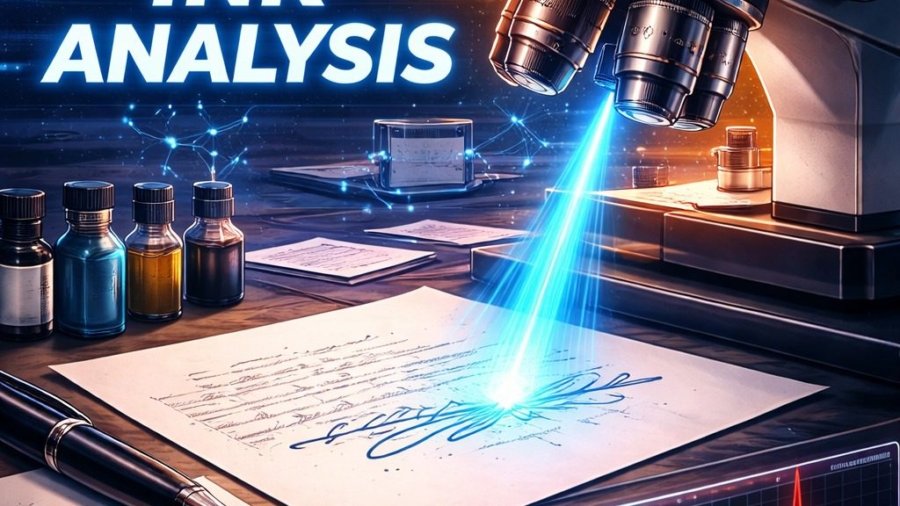
Ink differentiation is the process of distinguishing between different inks used in a document. In other words, it helps determine whether multiple inks were used at different times or by different individuals.

Furthermore, this technique is especially useful in cases involving:

  • Altered legal documents
  • Forged signatures
  • Added or modified text

Therefore, it plays a vital role in forensic investigations.

Introduction to Chromatography

Chromatography is a laboratory technique used to separate components of a mixture. In the context of forensic science, it helps break down ink into its chemical components.

Typically, inks contain dyes, pigments, and solvents. By separating these elements, forensic experts can compare different ink samples accurately.

Types of Chromatography Used in Ink Analysis

Paper Chromatography

First of all, paper chromatography is one of the simplest and most commonly used methods. A small ink sample is placed on paper and exposed to a solvent, which separates the ink into different रंग components.

Thin Layer Chromatography (TLC)

Next, TLC uses a coated plate instead of paper. As a result, it provides more precise separation and better analysis of ink components.

Gas Chromatography

Additionally, gas chromatography is used for analyzing volatile components of ink, such as solvents.

High-Performance Liquid Chromatography (HPLC)

Finally, HPLC is an advanced technique that offers highly accurate results and is widely used in forensic laboratories.

How Chromatography Helps in Ink Differentiation

Chromatography works by separating ink into its individual chemical components. As a result, each ink produces a unique pattern, often called a chromatogram.

For example, two inks that appear identical to the naked eye may show completely different patterns when analyzed.

Therefore, experts can:

  • Identify different inks used in a document
  • Determine whether additions were made later
  • Link ink to a specific pen or source

Importance in Forensic Document Examination

Ink differentiation is crucial for verifying document authenticity. In many cases, criminals attempt to alter documents by adding or changing information.

However, chromatography can reveal these changes by detecting inconsistencies in ink composition.

Moreover, it helps forensic experts:

  • Establish timelines for writing
  • Detect forgery and alterations
  • Provide scientific evidence in court

Challenges in Ink Differentiation

Sample Destruction

On one hand, some chromatography techniques require small samples, which may slightly damage the document.

Similar Ink Composition

On the other hand, modern inks may have similar chemical compositions, making differentiation difficult.

Environmental Factors

Additionally, exposure to light, heat, and moisture can affect ink composition over time.

Role of Technology in Modern Ink Analysis

With technological advancements, ink differentiation has become more precise. For instance, digital imaging and spectroscopy are often combined with chromatography for better results.

Furthermore, automated systems can analyze chromatograms quickly and accurately.

Consequently, these innovations enhance the reliability of forensic examinations.

Applications of Chromatography in Forensics

Chromatography techniques are widely used in:

  • Document forgery detection
  • Fraud investigations
  • Historical document analysis
  • Legal dispute resolution

In addition, they are also used in other forensic fields such as drug analysis and toxicology.

Conclusion

To sum up, ink differentiation using chromatography techniques is a powerful tool in forensic document examination. By separating ink into its chemical components, experts can detect alterations and verify authenticity.

Ultimately, as forensic science continues to evolve, these techniques will remain essential in combating document fraud and ensuring justice.

ChatGPT Image Mar 18, 2026, 04_12_22 PM

Erased Pencil Writing Detection in Forensic Investigations

Erased Pencil Writing Detection in Forensic Investigations

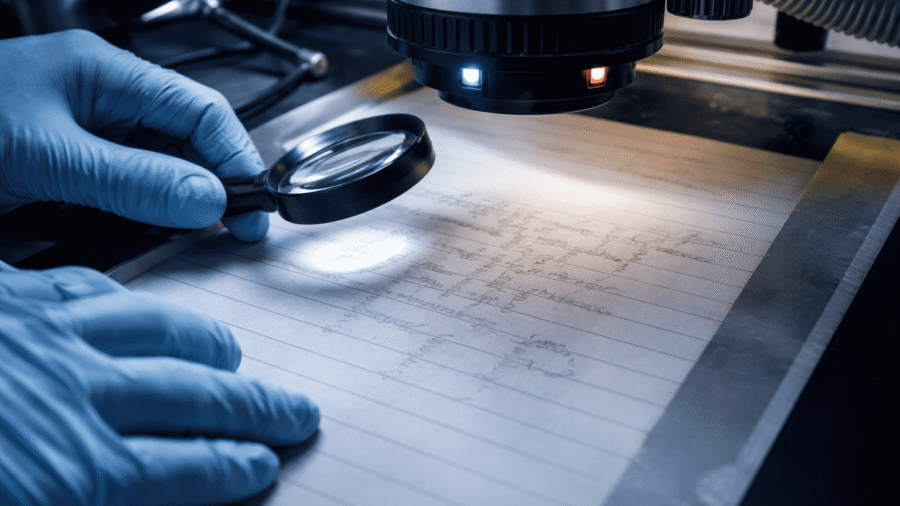
Erased pencil writing detection is a vital technique in forensic investigations. Experts use it to uncover hidden or removed information in questioned documents. Even when someone erases pencil marks, pressure impressions often remain on paper. Therefore, forensic specialists can recover this hidden evidence using scientific methods.

Why Erased Pencil Writing Detection Matters

Erasing pencil writing does not completely remove all traces. When a person writes, the pencil creates indentations on the paper surface. These impressions remain even after erasing.

Because of this, erased pencil writing detection helps investigators reveal hidden notes, altered numbers, or erased signatures. This technique plays an important role in forensic document examination and supports criminal investigations.

Techniques Used in Erased Pencil Writing Detection

Experts apply several reliable methods to recover erased writing. Each technique helps reveal different types of hidden information.

ESDA in Erased Pencil Writing Detection

The Electrostatic Detection Method (ESDA) is widely used in forensic labs. It detects indented writing left on paper.

This technique uses electrostatic charges to make hidden impressions visible. As a result, investigators can recover writing without damaging the document.

Oblique Lighting for Erased Writing

Oblique lighting is a simple yet effective technique. Investigators shine light at a low angle across the paper.

This process highlights surface indentations created during writing. It helps reveal erased content clearly.

Microscopic Analysis

Microscopic examination allows experts to observe tiny graphite particles and paper fibers. Even after erasing, small traces often remain.

This method confirms whether someone intentionally altered the document.

Digital Imaging Techniques

Modern tools enhance erased writing using high-resolution scanning and software. These tools improve contrast and visibility.

As a result, erased pencil writing detection becomes faster and more accurate.

Importance in Criminal Cases

Recovered writing often provides strong evidence. Investigators may uncover erased financial entries, hidden messages, or altered documents.

This evidence helps establish facts in fraud, forgery, and legal disputes. Courts accept such findings when experts present proper analysis.

Challenges in Detection

Although effective, this process has limitations. Heavy erasing can damage paper and reduce visible impressions.

Environmental factors like moisture and heat may also affect the document. Therefore, experts must handle evidence carefully.

Conclusion

Erased pencil writing detection remains a powerful tool in forensic investigations. Techniques like ESDA, lighting, and digital imaging help uncover hidden evidence.

As technology improves, forensic experts continue to enhance detection methods. This ensures that even erased information can support justice and legal decisions.


ChatGPT Image Mar 14, 2026, 11_38_40 AM

How Burned or Damaged Documents Are Recovered in Forensic Investigations

How Burned or Damaged Documents Are Recovered in Forensic Investigations

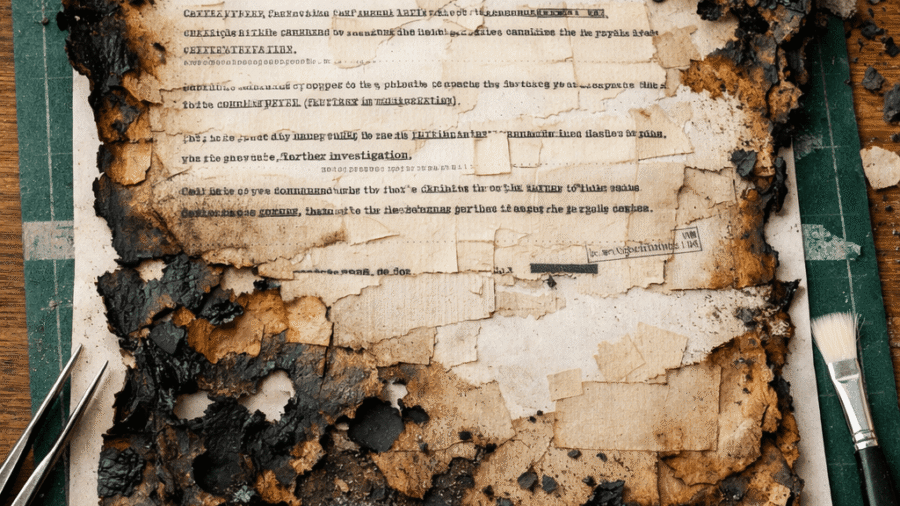
Burned or damaged document recovery plays a critical role in forensic investigations. Criminals often attempt to destroy evidence by burning or damaging important papers such as contracts, letters, receipts, or financial records. However, even severely damaged documents may still contain valuable information. Forensic experts use specialized techniques and tools to recover and analyze these documents. By applying scientific methods, investigators can often restore text, signatures, or markings that criminals tried to hide.

Importance of Burned or Damaged Document Recovery

Burned or damaged documents frequently appear in criminal investigations involving fraud, arson, financial crimes, and other illegal activities. Suspects may attempt to destroy evidence by burning documents or exposing them to water, chemicals, or physical damage.

However, destroying paper completely is more difficult than many criminals expect. Even partially burned documents may preserve fragments of text or structural patterns. Because of this, investigators carefully collect and analyze every piece of evidence found at the crime scene.

Experts often perform this analysis in questioned document examination, an important branch of forensic science. Through scientific examination, specialists can recover valuable information that supports criminal investigations.

Collection of Burned or Damaged Documents

Proper evidence collection is the first step in recovering burned or damaged documents. Investigators must handle fragile documents carefully to avoid further destruction.

First, investigators secure the crime scene to protect the evidence. They then collect document fragments using gloves, tweezers, or special tools. Burned paper becomes extremely fragile, so careful handling is essential.

Next, investigators place the recovered fragments into protective containers or envelopes. This process prevents additional damage during transportation to the forensic laboratory.

Finally, experts document the location and condition of each piece of evidence to maintain a proper chain of custody.

Techniques Used to Recover Burned Documents

Forensic laboratories use several techniques to recover information from burned documents.

Visual Reconstruction

In some cases, investigators can physically reconstruct burned documents by arranging fragments together like a puzzle. By matching torn edges and paper patterns, experts can restore the document’s original structure.

Once the fragments are assembled, investigators may identify letters, words, numbers, or signatures that survived the burning process.

Specialized Lighting Techniques

Special lighting methods help investigators reveal hidden or faint text. For example, experts may use Ultraviolet Light or infrared illumination to detect writing that is not visible under normal lighting conditions.

These lighting techniques can reveal ink traces, erased marks, or faded characters that remain on the damaged paper.

Digital Imaging Technology

Modern forensic laboratories also rely on advanced digital imaging systems. High-resolution scanners and digital microscopes allow investigators to capture detailed images of fragile document fragments.

Digital enhancement software helps increase contrast, sharpen faded text, and reveal hidden patterns. These tools allow experts to analyze even the smallest details without physically touching the fragile evidence.

Recovery of Water-Damaged Documents

Not all damaged documents are burned. Sometimes criminals attempt to destroy evidence by soaking documents in water or exposing them to moisture.

Water-damaged paper may contain blurred ink or distorted fibers. However, forensic experts can often recover information by carefully drying the documents and using specialized imaging techniques.

Investigators may also use chemical methods to stabilize ink and prevent further spreading. Once the document is stabilized, experts can analyze the text and identify important information.

Challenges in Burned Document Recovery

Despite advances in technology, recovering burned or damaged documents presents several challenges. Severe heat can destroy ink, leaving little visible information.

Additionally, missing fragments can prevent investigators from reconstructing the entire document. Environmental conditions, such as fire, smoke, or water, may also damage the paper’s structure.

However, experienced forensic experts often recover partial information even from heavily damaged documents. Sometimes, even a small fragment can provide critical clues during an investigation.

Role of Forensic Experts in Document Recovery

Forensic document examiners play an important role in analyzing damaged documents. These specialists use microscopes, imaging equipment, and scientific methods to study paper fibers, ink residues, and writing patterns.

Experts carefully document their findings and prepare forensic reports describing the recovered information. They often also provide expert testimony in court to explain how they recovered and analysed the document evidence.

Their work helps investigators uncover hidden information and strengthen criminal cases.

Conclusion

Recovering burned or damaged documents remains an essential part of forensic investigations. Even when criminals attempt to destroy important evidence, forensic experts can often recover valuable information through scientific analysis.

By combining careful evidence collection, specialized lighting techniques, and advanced digital imaging technology, investigators restore damaged documents and reveal hidden details. These techniques ensure that critical evidence survives and contributes to the pursuit of justice.

ChatGPT Image Mar 13, 2026, 10_54_54 AM

How Forged Cheques Are Detected in Banking Fraud

How Forged Cheques Are Detected in Banking Fraud

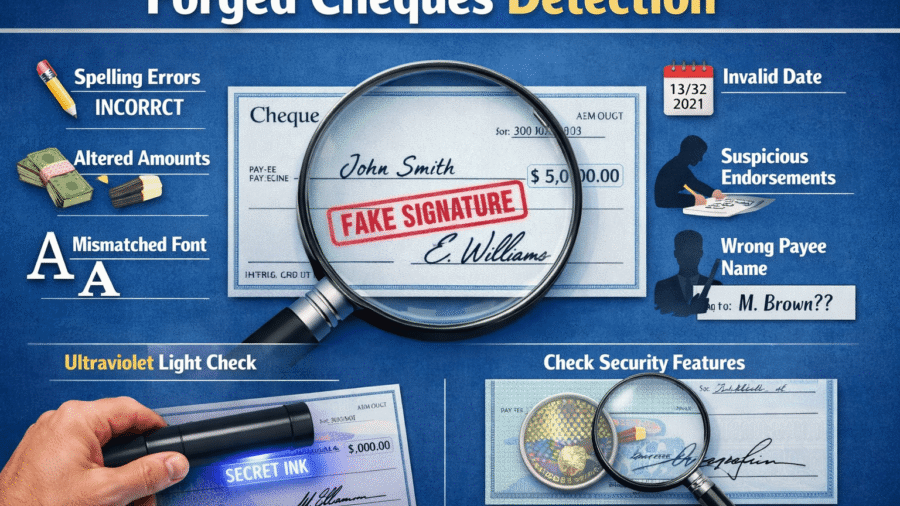
Forged cheques detection is an important part of banking fraud investigations. Criminals often try to steal money by altering or creating fake cheques. They may copy signatures, change amounts, or modify payee names to deceive banks. However, financial institutions and forensic experts use several advanced techniques to detect these fraudulent activities. By examining cheque details carefully, investigators can identify forgery and prevent financial losses.

Understanding Forged Cheques Detection

A forged cheque is a financial document that contains false or altered information. Fraudsters may produce completely fake cheques or modify genuine ones to withdraw money illegally.

Banks rely on multiple verification methods to detect these fraudulent documents. Experts often apply techniques from Questioned Document Examination, which is an important branch of Forensic Science. Through detailed analysis of signatures, ink, paper, and security features, investigators identify suspicious alterations.

Therefore, forged cheques detection helps banks maintain financial security and protect customers from fraud.

Common Types of Cheque Forgery

Fraudsters use several methods to manipulate cheques. Understanding these methods allows banks to detect suspicious transactions more effectively.

Signature Forgery

Signature forgery occurs when a criminal imitates the account holder’s signature. Fraudsters attempt to copy the handwriting style to make the cheque appear authentic.

However, forensic document examiners analyze handwriting characteristics such as pen pressure, stroke direction, spacing, and letter formation. These writing patterns usually reveal differences between genuine and forged signatures.

Altered Cheques

In many cases, criminals alter genuine cheques instead of creating new ones. They may change the cheque amount, modify the date, or replace the payee name.

Fraudsters sometimes erase the original ink using chemicals or mechanical erasers. After removing the text, they write new information on the cheque. Investigators can still detect these alterations using specialized forensic tools.

Counterfeit Cheques

Counterfeit cheques are completely fabricated documents designed to imitate real bank cheques. Criminals may copy bank logos, cheque layouts, and account numbers.

Banks detect counterfeit cheques by comparing them with official cheque templates and verifying built-in security features.

Techniques Used in Forged Cheques Detection

Banks and forensic investigators use multiple examination methods to detect cheque fraud. These techniques allow experts to identify even subtle signs of forgery.

Handwriting and Signature Analysis

Handwriting analysis plays a major role in forged cheques detection. Investigators compare the signature on the cheque with verified signature samples from the account holder.

Experts examine writing speed, pen pressure, connecting strokes, and letter proportions. Genuine signatures usually show natural flow, while forged signatures often display hesitation or tremors.

Therefore, handwriting analysis helps identify whether someone forged the signature.

Ink and Paper Examination

Investigators also analyze the ink and paper used in the cheque. Differences in ink color, writing pressure, or chemical composition may indicate document tampering.

Special lighting techniques reveal erased or overwritten text. For example, experts use Ultraviolet Light to detect hidden alterations that cannot be seen under normal lighting.

Paper analysis also helps investigators determine whether the cheque came from an authentic cheque book or a counterfeit source.

Security Feature Verification

Banks include several built-in security features to prevent cheque fraud. These features may include watermarks, microprinting, magnetic ink, and holograms.

Bank officials carefully verify these elements during cheque processing. Missing or damaged security features often indicate potential forgery.

Digital Fraud Monitoring

Modern banks also rely on digital systems to detect suspicious cheque transactions. Fraud detection software analyzes customer transaction patterns and flags unusual activity.

For example, the system may generate alerts when cheque amounts suddenly increase or when multiple cheques appear within a short period. Financial institutions often follow security guidelines issued by the Reserve Bank of India to strengthen fraud detection procedures.

Role of Forensic Document Experts

When banks suspect cheque forgery, forensic document experts conduct detailed examinations. These specialists use microscopes, digital imaging tools, and specialized lighting equipment to analyze suspicious cheques.

Experts document their observations and prepare forensic reports explaining the signs of forgery. In legal cases, they may also present expert testimony in court to support fraud investigations.

Because forensic experts follow scientific procedures, their analysis plays an important role in proving banking fraud.

Preventing Cheque Fraud

Banks and customers can take several steps to reduce the risk of cheque fraud. Financial institutions continuously improve cheque security features and monitoring systems.

Customers should also protect their cheque books and review bank statements regularly. Reporting suspicious transactions immediately helps banks stop fraudulent activity quickly.

In addition, many banks encourage customers to use secure digital payment methods instead of paper cheques whenever possible.

Conclusion

Forged cheques detection remains a critical part of banking fraud prevention. Through handwriting analysis, ink examination, security feature verification, and digital monitoring, banks and forensic experts can identify fraudulent cheques effectively.

These forensic techniques help protect financial institutions and customers from fraud. As banking technology continues to evolve, stronger detection systems will further reduce the risks associated with cheque forgery.

ChatGPT Image Mar 12, 2026, 10_50_42 AM

How Ultraviolet Light Reveals Hidden Alterations in Documents

How Ultraviolet Light Reveals Hidden Alterations in Forensic Documents

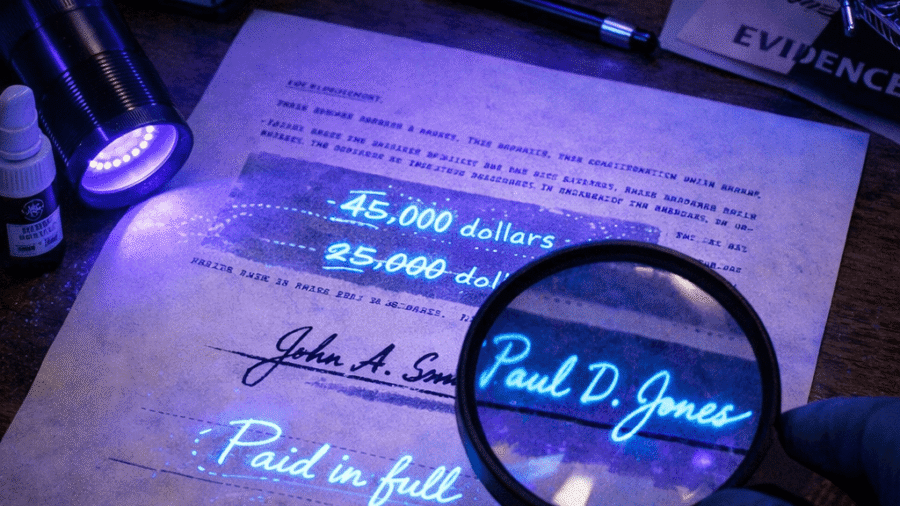
Ultraviolet light in document examination plays an important role in modern forensic investigations. Many criminals attempt to alter documents by erasing, overwriting, or modifying information. These alterations may look invisible under normal lighting. However, forensic experts can detect such hidden changes using ultraviolet light. By exposing documents to ultraviolet radiation, investigators can identify erased writing, ink differences, and other signs of tampering.

Role of Ultraviolet Light in Document Examination

Ultraviolet light in document examination helps forensic scientists analyze documents that may contain hidden or altered information. Ultraviolet radiation belongs to a part of the electromagnetic spectrum that the human eye cannot see. However, when forensic experts shine ultraviolet light on a document, certain materials react differently.

For example, paper, ink, and correction fluids often absorb or reflect ultraviolet light in unique ways. As a result, hidden alterations may appear as glowing, darkened, or fluorescent areas. Because of this property, investigators frequently use ultraviolet examination in the field of Forensic Science and Questioned Document Examination.

How Ultraviolet Light Detects Hidden Alterations

Forensic specialists use ultraviolet light in document examination to reveal changes that remain invisible under normal light. First, investigators place the document under a controlled ultraviolet lamp. Then they observe how different areas react to the light.

Several types of alterations can be detected using this technique:

  • Erasures: Mechanical erasing damages paper fibers. Under ultraviolet light, these damaged areas reflect light differently.
  • Ink differences: Two inks may look identical in daylight but show clear differences under ultraviolet radiation.
  • Overwriting: Added text often appears darker or brighter when exposed to ultraviolet light.
  • Correction fluids: Chemical substances used to hide text may fluoresce under ultraviolet light.

Therefore, ultraviolet examination allows investigators to detect document tampering quickly and accurately.

Ultraviolet Light and Ink Analysis

Another important use of ultraviolet technology involves ink analysis. Different inks contain different chemical compositions. When exposed to ultraviolet radiation, these chemicals react in distinct ways.

For instance, one ink may glow brightly while another appears dull or dark. This reaction helps investigators determine whether someone added new information to a document after its creation. Often, this technique reveals fraudulent alterations in contracts, financial records, or official forms.

Because of these advantages, ultraviolet light in document examination remains a valuable method in forensic laboratories.

Use of Technology in Ultraviolet Document Analysis

Modern forensic laboratories combine ultraviolet light with advanced digital imaging technology. High-resolution cameras capture images of documents under ultraviolet illumination. Investigators can then analyze these images using specialized software.

Digital analysis allows experts to zoom in on tiny details such as ink strokes, paper fibers, and surface damage. In addition, digital enhancement improves contrast between altered and original areas of the document.

These technological improvements increase the accuracy of forensic document analysis and help experts present clear evidence in court.

Advantages of Ultraviolet Light in Document Examination

Ultraviolet analysis offers several advantages for forensic investigations.

First, the method is non-destructive. Investigators can examine documents without damaging the original evidence.

Second, ultraviolet light reveals alterations that remain invisible under normal lighting conditions. Consequently, investigators can uncover hidden information without physically modifying the document.

Third, the process is relatively quick and efficient. Forensic laboratories often use ultraviolet light as an initial screening method before performing advanced chemical tests.

Limitations of Ultraviolet Document Examination

Despite its usefulness, ultraviolet examination also has limitations. Some inks and papers react very similarly to ultraviolet light, making differences harder to detect.

Additionally, environmental conditions such as ageing, sunlight exposure, or moisture may affect how materials respond to ultraviolet radiation. Therefore, forensic experts often combine ultraviolet examination with other techniques such as infrared analysis or microscopic inspection.

Using multiple forensic methods ensures more reliable results during document analysis.

Conclusion

Ultraviolet light in document examination plays a crucial role in detecting hidden alterations in forensic documents. By exposing documents to ultraviolet radiation, investigators can reveal erased writing, ink differences, and signs of tampering that remain invisible to the naked eye.

This technique supports criminal investigations by uncovering important evidence hidden within documents. As forensic technology continues to advance, ultraviolet examination will remain an essential tool for document analysis and fraud detection.

ChatGPT Image Mar 11, 2026, 10_51_44 AM

Forensic Examination of Torn Documents

Forensic Examination of Torn Documents

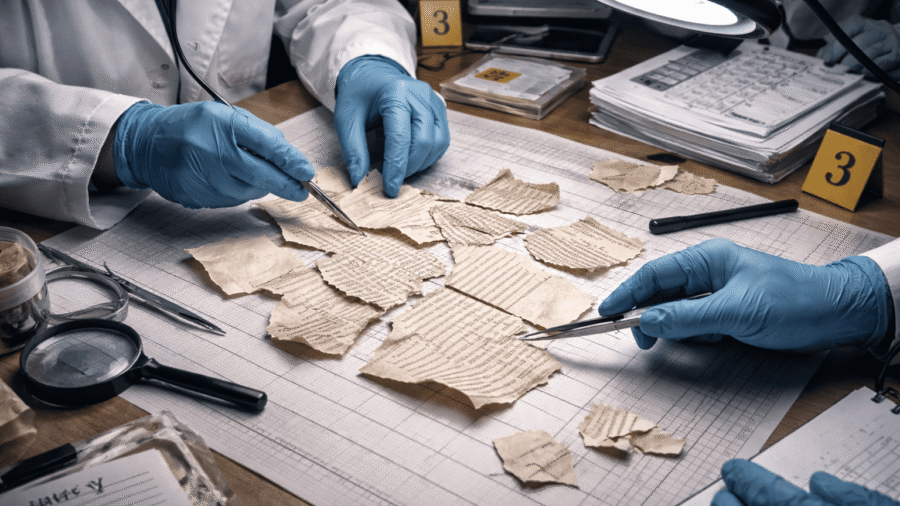
Documents often play a critical role in criminal investigations. Letters, agreements, receipts, and handwritten notes can reveal important details about a crime. However, suspects sometimes try to destroy evidence by tearing documents into pieces. Even so, investigators can still recover valuable information. The forensic examination of torn documents helps experts reconstruct damaged papers and uncover hidden evidence.

Understanding Torn Document Examination

Torn document examination focuses on analyzing pieces of damaged paper to restore their original form. This method belongs to the field of Questioned Document Examination, which is an important branch of Forensic Science.

First, forensic experts collect the torn fragments carefully. Next, they study the pieces and try to rebuild the original document. In many cases, the fragments contain handwritten text, printed words, numbers, or signatures. Therefore, reconstructing the document can reveal information that criminals attempted to hide.

Importance in Criminal Investigations

Torn documents frequently appear in criminal cases. For instance, suspects may destroy letters, contracts, or financial records to remove evidence. However, tearing a document rarely removes all traces of information.

Because of this, investigators carefully examine every fragment. Once experts reconstruct the document, it may reveal critical details about the crime. For example, a reconstructed paper might expose a fraudulent agreement, a threatening letter, or an illegal transaction.

Furthermore, courts often accept reconstructed documents as evidence. As a result, the recovered material can help investigators connect suspects to criminal activities.

Collection of Torn Document Evidence

Proper evidence collection is essential during torn document investigations. First, investigators secure the crime scene to prevent contamination. Then, they collect each fragment using gloves or tweezers.

Next, they place the pieces in protective envelopes or containers. This step prevents further damage and keeps the fragments organized. Additionally, investigators label every piece to maintain proper identification.

Most importantly, investigators maintain the chain of custody. This record shows who handled the evidence at each stage. Consequently, the document fragments remain reliable for legal proceedings.

Methods Used to Reconstruct Torn Documents

Experts use several techniques to reconstruct torn documents. Initially, they perform a detailed visual examination of the fragments. They closely observe the torn edges, paper fibers, and patterns.

After that, they arrange the fragments on a flat surface. Gradually, they match the irregular edges like a puzzle. Because torn edges have unique shapes, experts can often identify the correct matches.

Once the fragments fit together, investigators secure them using transparent sheets or special adhesive materials. Finally, they document the reconstructed document for further analysis.

Use of Modern Technology

Modern technology has improved the process of document reconstruction. Today, forensic laboratories often use digital imaging tools to analyze fragments more accurately.

For example, experts scan each fragment using high-resolution scanners. Then they examine the images on a computer screen. This method allows them to zoom in on small details such as ink strokes or paper fibers.

In addition, special lighting techniques reveal hidden information. For instance, Ultraviolet Light can expose faded writing, erased marks, or alterations that remain invisible under normal lighting.

Therefore, technology greatly increases the accuracy and efficiency of torn document analysis.

Challenges in Torn Document Examination

Despite these advancements, experts still face several challenges. Sometimes investigators find hundreds of tiny fragments at a crime scene. Sorting and matching these pieces requires time and patience.

Moreover, missing fragments can create difficulties. If important pieces disappear, experts cannot fully reconstruct the document.

Environmental damage also complicates the process. For instance, water, fire, or chemicals may damage the paper and ink. Nevertheless, skilled forensic specialists often recover partial information even in difficult cases.

Role in Court Proceedings

After reconstruction, experts prepare detailed forensic reports. These reports explain the methods used and the results obtained during the analysis.

Furthermore, forensic specialists may present their findings in court. During testimony, they explain how they reconstructed the document and identified important details.

Because experts follow scientific procedures, courts usually accept reconstructed documents as reliable evidence. Consequently, these documents often play a key role in proving fraud, forgery, or other crimes.

Conclusion

The forensic examination of torn documents remains an important technique in criminal investigations. Even when suspects try to destroy evidence, forensic experts can often recover valuable information.

Through careful collection, reconstruction, and analysis, investigators restore damaged papers and reveal hidden details. Moreover, modern technology continues to improve the accuracy of this process. As a result, torn document analysis helps ensure that important evidence is not lost and justice can be served.

ChatGPT Image Mar 6, 2026, 02_59_56 PM

Types of Forgery in Forensic Document Examination

Introduction

Types of forgery in forensic document examination play a crucial role in identifying document fraud. Forgery is one of the most common crimes investigated in forensic science. In simple terms, forgery involves creating, altering, or copying a document with the intent to deceive.

Today, forgery cases frequently involve legal documents, financial transactions, contracts, and identity papers. Therefore, understanding the different types of forgery is essential for investigators, legal professionals, and forensic experts.

What is Forgery in the Forensic Document Examination?

In forensic science, forgery refers to any attempt to falsify handwriting, signatures, or documents. Experts in forensic document examination analyze:

  • Handwriting characteristics
  • Signature patterns
  • Ink and paper composition
  • Writing instruments

As a result, they can determine whether a document is genuine or forged.

Main Types of Forgery in Forensic Document Examination

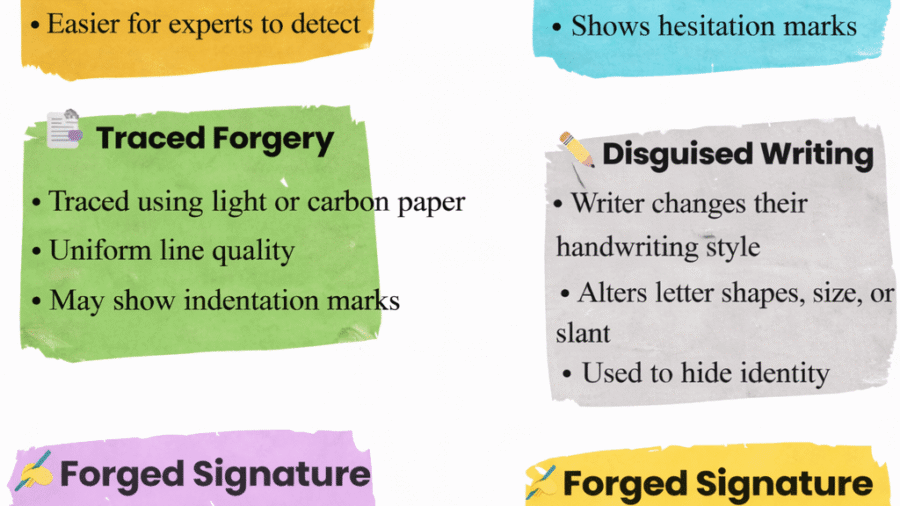
1. Simple Forgery (Freehand Forgery)

Simple forgery, also known as freehand forgery, occurs when a person reproduces someone else’s handwriting from memory.

Since the forger does not copy directly from the original, the writing usually shows noticeable differences.

Key Characteristics:

  • Irregular letter shapes
  • Poor spacing and proportions
  • Lack of consistency

Therefore, this type of forgery is relatively easy to detect. 2. Simulated Forgery

Simulated forgery involves carefully copying a signature or handwriting while observing the original.

Although it may appear accurate at first glance, detailed examination reveals flaws.

Key Characteristics:

  • Slow and hesitant strokes
  • Pen lifts and tremors
  • Unnatural writing rhythm

Consequently, forensic experts can identify signs of imitation.

3. Traced Forgery

Traced forgery occurs when a person traces original writing using tools like:

  • Carbon paper
  • Light boxes
  • Transparent sheets

This method produces a close visual copy, but it lacks natural writing features.

Key Characteristics:

  • Uniform line quality
  • Tremors in strokes
  • Indentation marks on paper

 As a result, traced forgeries can be detected using specialized forensic techniques.

4. Disguised Writing

Disguised writing is different from other types of forgery. In this case, a person alters their handwriting to hide their identity.

For example, they may change the following:

  • Letter size
  • Writing slant
  • Spacing
  • Writing speed

However, it is extremely difficult to eliminate natural handwriting habits. Therefore, experts can still identify the writer.

5. Forged Signature (Signature Forgery)

Signature forgery is one of the most common forms of document fraud. It involves signing another person’s name without authorisation.

This type is frequently seen in:

  • Cheques
  • Contracts
  • Legal agreements

Key Characteristics:

  • Variation in pen pressure
  • Incorrect stroke sequence
  • Lack of natural flow

 Consequently, forensic examiners can detect forged signatures through detailed analysis.

Importance of Identifying Types of Forgery

Understanding the types of forgery in forensic document examination helps in:

  • Detecting fraud and criminal activity
  • Supporting legal investigations
  • Providing expert evidence in court
  • Preventing financial and identity crimes

Therefore, forensic document examination is essential in modern justice systems.

Conclusion

In conclusion, forgery remains a major challenge in document-related crimes. The primary types include:

  • Simple (freehand) forgery
  • Simulated forgery
  • Traced forgery
  • Disguised writing
  • Signature forgery

Each type has unique characteristics. However, forensic experts use scientific methods to detect even the most sophisticated forgeries.

Ultimately, forensic document examination plays a vital role in ensuring authenticity, preventing fraud, and supporting justice.

WhatsApp Image 2026-03-06 at 09.50.24

Raman Spectroscopy in Ink Analysis: A Modern Breakthrough in Questioned Document Examination

Raman Spectroscopy in Ink Analysis: A Modern Breakthrough in Questioned Document Examination

In forensic science, questioned document examination plays a vital role in detecting forgery, document alterations, and financial fraud. Investigators often rely on scientific techniques to determine whether a document has been modified or falsified. Among the most advanced tools used today is Raman spectroscopy, a powerful analytical technique that allows forensic experts to study the chemical composition of ink without damaging the document.

Traditionally, investigators used chemical methods that required removing small samples of ink from paper. However, these methods could potentially damage valuable evidence. Therefore, non-destructive techniques such as Raman spectroscopy have become increasingly important in forensic laboratories. By analyzing ink directly on paper, forensic experts can preserve evidence while still obtaining detailed chemical information.

This article explains how Raman spectroscopy works, why ink analysis is important in forensic investigations, and how this technology strengthens questioned document examination.

What is Raman Spectroscopy?

Raman spectroscopy is a non-destructive analytical technique used to identify the molecular composition of materials. The technique works by directing a laser beam onto a sample and measuring how the light scatters after interacting with molecular vibrations.

When the laser light interacts with molecules in the ink, a small portion of the light changes energy. As a result, the scattered light produces a unique spectral pattern known as a Raman spectrum. Each material generates a distinctive spectral signature, which acts like a chemical fingerprint.

Consequently, forensic scientists can identify the chemical components of an ink sample without physically removing it from the document. This capability makes Raman spectroscopy particularly valuable in legal investigations where preserving evidence is essential.

Importance of Ink Analysis in Forensic Investigations

Ink analysis plays a crucial role in cases involving document fraud and forgery. At first glance, two pens may appear identical in color. However, their chemical compositions often differ significantly. These subtle differences allow forensic experts to determine whether a document has been altered.

Forensic investigators commonly perform ink analysis in cases involving:

  • Forged signatures

  • Altered contracts

  • Fraudulent wills

  • Backdated financial documents

  • Anonymous letters and threatening notes

Through chemical analysis, experts can determine several important factors. For example, they may discover whether multiple inks were used in the same document or whether an entry was added later.

Traditionally, techniques such as thin-layer chromatography (TLC) were widely used for ink analysis. However, these methods require removing ink samples from the paper, which can damage important evidence. Raman spectroscopy, in contrast, provides a safer and more efficient alternative.

How Raman Spectroscopy Works in Ink Analysis

Raman spectroscopy follows a systematic process when analyzing ink samples.

1. Laser Excitation

First, the examiner directs a focused laser beam onto a very small area of ink on the document.

2. Detection of Scattered Light

Next, the instrument measures the scattered light produced when the laser interacts with the ink molecules.

3. Spectrum Generation

The scattered light generates a Raman spectrum that contains peaks corresponding to specific molecular vibrations.

4. Database Comparison

Finally, the examiner compares the obtained spectrum with reference databases to identify the chemical composition of the ink.

Because every ink formulation contains unique dyes, pigments, solvents, and additives, Raman spectroscopy can detect even subtle differences between inks.

Advantages of Raman Spectroscopy in Ink Analysis

Raman spectroscopy offers several significant advantages in forensic document examination.

Non-Destructive Examination

One of the most important advantages is that the technique does not damage the document. Therefore, investigators can analyze evidence without compromising its integrity for courtroom presentation.

Minimal Sample Preparation

Unlike many chemical techniques, Raman spectroscopy requires little or no sample preparation. Consequently, the risk of contamination decreases, and the analysis process becomes faster.

High Chemical Specificity

Each ink produces a distinct Raman spectrum. As a result, forensic experts can accurately differentiate inks that appear visually identical.

Detection of Ink Layers

In some cases, Raman spectroscopy can distinguish overlapping ink layers. This capability helps investigators determine the sequence of writing strokes, which is extremely important in forgery investigations.

Microscopic Precision

Modern micro-Raman instruments allow examiners to analyze extremely small areas of ink, including individual pen strokes.

Applications in Real Forensic Cases

Raman spectroscopy has proven valuable in a wide range of forensic investigations.

For instance, investigators have used the technique to examine:

  • Disputed signatures in property agreements

  • Suspected backdating of financial documents

  • Altered legal contracts

  • Anonymous threat letters

  • Ransom notes

In many cases, Raman analysis has revealed chemical differences between inks that appear identical to the naked eye. Consequently, investigators were able to prove that certain entries were added at a later time.

Raman Spectroscopy vs Traditional Ink Analysis Methods

Feature Thin-Layer Chromatography (TLC) Raman Spectroscopy
Destructive Yes No
Sample Removal Required Yes No
Speed Moderate Fast
Chemical Specificity High Very High
Evidence Preservation Limited Excellent

Although TLC remains useful in certain situations, Raman spectroscopy provides a more advanced and evidence-friendly method for modern forensic laboratories.

Challenges and Limitations

Despite its many advantages, Raman spectroscopy also has certain limitations.

Fluorescence Interference

Some paper materials or ink components produce fluorescence when exposed to laser light. As a result, fluorescence may sometimes interfere with Raman signals.

High Equipment Cost

Advanced Raman instruments are expensive. Therefore, smaller forensic laboratories may have limited access to this technology.

Need for Expert Interpretation

Spectral data requires trained experts for accurate interpretation. Proper database comparison and analytical experience are essential for reliable results.

To overcome these limitations, laboratories often combine Raman spectroscopy with complementary techniques such as infrared spectroscopy.

Role of Raman Spectroscopy in Courtroom Evidence

Forensic techniques must meet strict scientific standards before they are accepted in court. Raman spectroscopy satisfies many of these requirements because it is based on well-established physical principles and produces reproducible results.

Moreover, the technique provides objective chemical data, which reduces the risk of subjective interpretation. When combined with other document examination methods, Raman spectroscopy significantly strengthens expert testimony in legal proceedings.

Future Trends in Raman-Based Ink Analysis

Technological advancements continue to expand the capabilities of Raman spectroscopy in forensic science.

Several promising developments are currently emerging, including:

  • Portable Raman devices for field investigations

  • Artificial intelligence for automated spectral interpretation

  • Expanded ink reference databases

  • Integration with hyperspectral imaging systems

As these technologies develop, Raman spectroscopy is likely to become a standard tool in forensic document examination worldwide.

Conclusion

Raman spectroscopy represents a major advancement in forensic ink analysis. Because the technique is non-destructive, precise, and scientifically reliable, it allows investigators to examine documents without damaging crucial evidence.

Although traditional techniques still play an important role, Raman spectroscopy provides a modern and highly effective method for detecting document alterations and forgery. Consequently, this technology continues to strengthen forensic investigations and support the pursuit of justice.

ChatGPT Image Mar 2, 2026, 11_06_09 AM

How to Preserve Documents for Forensic Examination

How to Preserve Documents for Forensic Examination

In legal disputes, financial frauds, property matters, and criminal investigations, documents often become the most crucial pieces of evidence. Whether it is a questioned signature, an altered agreement, a disputed will, or a suspected forged cheque, the value of a document depends not only on what it contains but also on how well it has been preserved. Improper handling can permanently damage forensic features, weaken expert opinions, and even make the document inadmissible in court.

This blog explains why document preservation matters and provides practical, step-by-step guidance on how to protect documents for forensic examination.

Why Proper Preservation Is Critical

Forensic document examination relies on subtle physical and chemical characteristics such as:

  • Ink distribution and flow

  • Pen pressure and line quality

  • Indentations on underlying pages

  • Paper texture, aging, and fiber composition

  • Sequence of writings or alterations

Poor handling—folding, stapling, lamination, exposure to moisture, or excessive photocopying—can destroy or distort these features. Once lost, such evidence cannot be recreated, even with advanced laboratory techniques.

Golden Rule: Preserve the Original Document

The original document always carries the highest evidentiary value. Photocopies, scans, or photographs may help for reference, but they cannot fully replace the original during forensic examination.

Best practices:

  • Never discard the original, even if copies exist

  • Submit the original whenever possible for expert analysis

  • Clearly label copies as “for reference only”

Avoid Unnecessary Handling

Every time a document is touched, there is a risk of contamination or damage.

Do’s:

  • Handle documents by the edges

  • Use clean, dry hands or gloves if available

  • Limit handling to essential personnel only

Don’ts:

  • Do not rub, trace, or write over the document

  • Do not place fingers on signatures, seals, or written areas

  • Avoid stacking documents loosely where friction can occur

Never Laminate or Tape Documents

Lamination is one of the most damaging actions for forensic evidence. Heat and adhesive permanently alter ink and paper characteristics.

Similarly, using transparent tape to repair torn documents can:

  • Destroy original fibers

  • Interfere with ink analysis

  • Obscure alterations or overwriting

If a document is torn or fragile, place it in a protective cover without attempting repairs.

Protect from Environmental Damage

Environmental factors can significantly degrade documents over time.

Protect documents from:

  • Moisture and humidity (causes ink bleeding and paper warping)

  • Direct sunlight (leads to fading and chemical changes)

  • Heat (accelerates paper and ink degradation)

  • Dust and insects

Recommended storage:

  • Clean, dry place

  • Acid-free folders or envelopes

  • Flat storage to prevent folds and creases

Do Not Fold or Staple Important Documents

Folds can:

  • Break ink lines

  • Distort pen pressure patterns

  • Damage paper fibers

Staples, pins, or clips can:

  • Create indentations mistaken for writing

  • Tear paper during removal

  • Corrode and stain documents over time

Instead, store documents flat in protective sleeves or folders.

Maintain the Chain of Custody

In legal and forensic contexts, how a document moved from one person to another matters.

Maintain records of:

  • Who discovered or received the document

  • Date, time, and place of collection

  • Every transfer between individuals or departments

A documented chain of custody strengthens the credibility of both the evidence and the forensic opinion in court.

Avoid Writing Notes on the Document

Never write case details, names, dates, or reference numbers on the document itself. Additional writing can interfere with examinations related to ink sequence, pressure, or indentation analysis.

If identification is necessary:

  • Use a separate label or envelope

  • Write notes on an accompanying sheet, not on the evidence

Preserve Associated Materials

Often, supporting materials can be just as important as the questioned document itself.

Preserve:

  • Envelopes containing letters or notices

  • Notepads beneath written pages

  • Pens suspected to be used

  • Related documents from the same time period

These materials may help in comparative analysis and reconstruction of events.

Consult a Forensic Expert Early

Early consultation can prevent irreversible mistakes. A forensic expert can advise on:

  • Proper handling and storage

  • Whether cleaning or drying is safe

  • The need for controlled laboratory conditions

Delaying expert guidance often results in lost opportunities for meaningful examination.

Common Mistakes to Avoid

  • Submitting only photocopies when originals are available

  • Laminating documents “for safety”

  • Folding documents to fit envelopes

  • Allowing multiple people to handle evidence casually

  • Exposing documents to water, fire, or chemicals

Conclusion

Document preservation is not a technical formality—it is the foundation of reliable forensic examination and legal credibility. A well-preserved document allows forensic experts to extract maximum information, supports strong expert opinions, and increases the chances of justice being served.

Whether you are a lawyer, investigator, organization, or private individual, treating documents with care from the very beginning can make the difference between a strong case and a compromised one. Remember, once damaged, forensic evidence cannot be undone.