
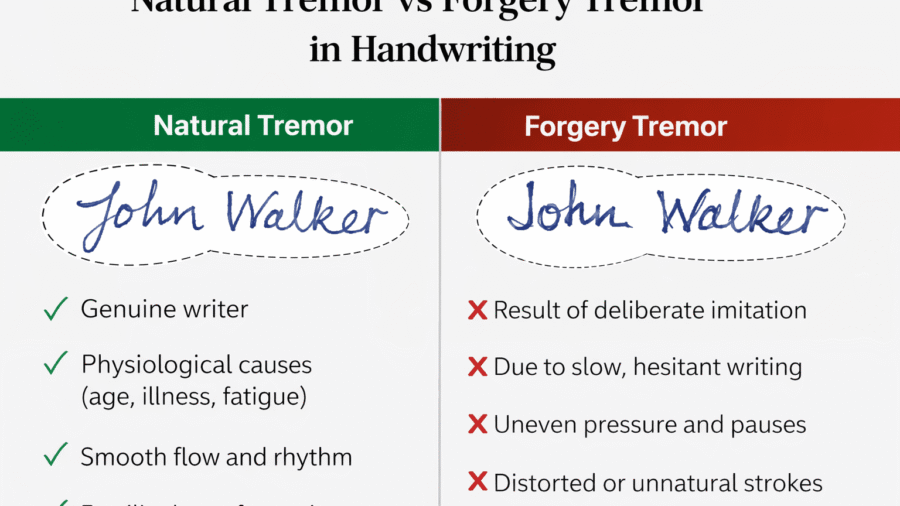
Handwriting Tremor Analysis: Natural Tremor vs Forgery Tremor
Introduction
Handwriting tremor analysis plays a crucial role in questioned document examination. In disputed signatures and handwritten documents, tremors often raise suspicion. However, not every tremor indicates forgery. In fact, many genuine writers naturally exhibit tremors due to age, health, or emotional factors. Therefore, forensic experts must carefully differentiate natural tremor from forgery tremor to avoid incorrect conclusions.
What Is Handwriting Tremor?
In forensic handwriting examination, a tremor refers to involuntary or irregular movement affecting writing strokes. During handwriting tremor analysis, examiners closely observe line quality, stroke continuity, rhythm, and pen pressure. Moreover, they evaluate tremors alongside writing speed and natural variation. As a result, experts never rely on tremor alone when forming opinions.
Natural Tremor in Handwriting Tremor Analysis
Natural tremor occurs without conscious control. For example, elderly individuals or people with medical conditions may show slight waviness in their writing. Nevertheless, this tremor does not disrupt writing fluency.
Key Characteristics of Natural Tremor
-
Consistent and rhythmic movement
-
Smooth stroke flow
-
Normal writing speed
-
Uniform appearance throughout the text
-
Natural variation preserved
Furthermore, natural tremor integrates seamlessly into handwriting. Writers continue writing without hesitation; consequently, strokes appear continuous rather than broken. In addition, both simple and complex letters show similar tremor patterns, which confirms genuineness.
Forgery Tremor in Handwriting Tremor Analysis
In contrast, forgery tremor results from deliberate effort. When a forger slowly draws letters instead of writing naturally, tremor becomes exaggerated. As a result, the writing loses rhythm and fluency.
Key Characteristics of Forgery Tremor
-
Irregular and uneven strokes
-
Frequent hesitation and pen lifts
-
Uneven pressure application
-
Tremor concentrated in curves
-
Lack of natural rhythm
Moreover, forgery tremor often appears only in specific areas where the forger struggles. Consequently, the tremor pattern lacks consistency. For example, straight strokes may appear smoother, while curved strokes show visible shakiness.
Natural Tremor vs Forgery Tremor: A Comparative View
| Feature | Natural Tremor | Forgery Tremor |
|---|---|---|
| Cause | Involuntary | Deliberate |
| Rhythm | Regular | Irregular |
| Speed | Normal | Slow |
| Stroke Flow | Continuous | Hesitant |
| Variation | Natural | Mechanical |
Thus, handwriting tremor analysis relies on pattern consistency rather than isolated features.
Importance of Handwriting Tremor Analysis in Forensic Cases
Handwriting tremor analysis significantly supports forensic opinions in signature disputes, property document cases, and fraud investigations. Moreover, courts rely on expert interpretation rather than visual judgment. Therefore, examiners combine tremor findings with spacing, alignment, stroke order, and pressure analysis.
Common Misconceptions About Tremors
Many people believe that shaky handwriting always indicates forgery. However, this assumption often leads to false allegations. Similarly, some assume tremor proves illness, which is also incorrect. Instead, forensic handwriting tremor analysis applies scientific comparison and contextual evaluation.
Limitations of Handwriting Tremor Analysis
Despite its value, handwriting tremor analysis has limitations. For instance, poor photocopies may hide fine details. Additionally, severe illness can sometimes mimic forgery tremor. Therefore, experts must interpret tremors cautiously and corroborate findings with other indicators.
Conclusion
In conclusion, handwriting tremor analysis helps forensic experts distinguish genuine writing from simulated attempts. While natural tremor reflects involuntary movement and consistency, forgery tremor reveals hesitation and conscious control. Consequently, a structured and comparative approach ensures reliable forensic opinions that support justice.
