ChatGPT Image Apr 11, 2026, 10_34_46 AM

Can Handwriting Predict Personality

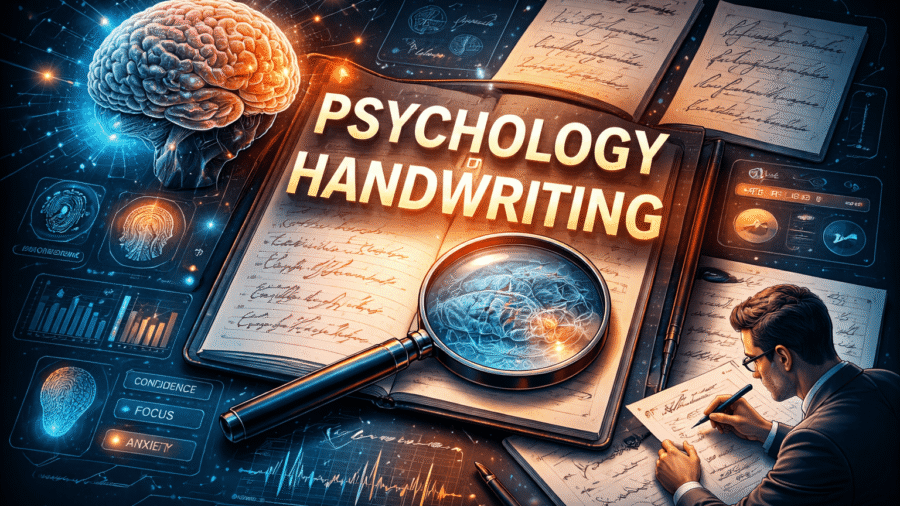
Handwriting is a unique human trait that reflects motor skills, habits, and learned patterns. However, a common question remains—can handwriting predict personality? Many people believe that the way we write reveals hidden aspects of our character. This idea forms the basis of personality studies in handwriting analysis, also known as graphology.

Therefore, it is important to separate scientific facts from popular myths when discussing handwriting and personality.

What is graphology?

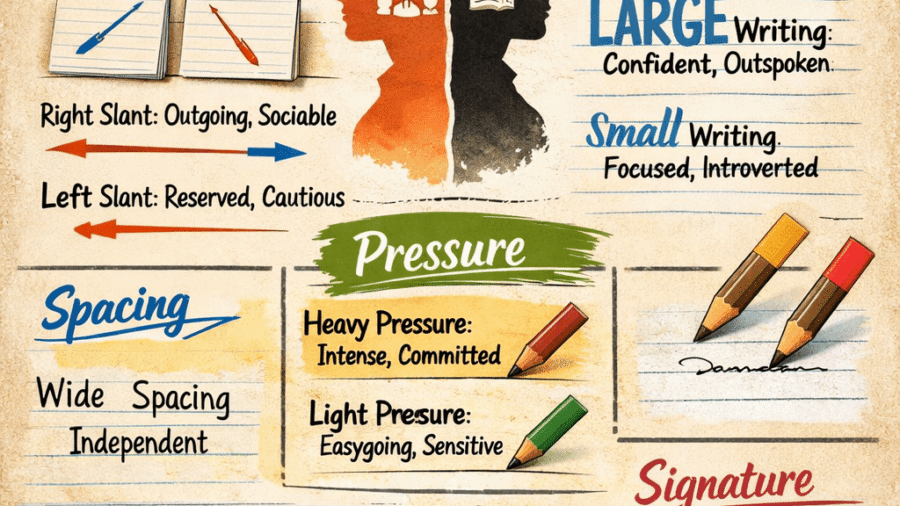
Graphology is the study of handwriting aimed at identifying personality traits. In simple terms, graphology suggests that handwriting reflects psychological characteristics. For example, analysts examine slant, spacing, size, and pressure to interpret behavior.

Moreover, graphology is widely used in non-forensic fields, such as recruitment and personal assessments. However, its scientific reliability remains debated.

 How Handwriting is Linked to Personality

Supporters of handwriting analysis believe that certain features of handwriting indicate specific personality traits. For instance:

  • Large handwriting may indicate confidence and extroversion
  • Small handwriting may suggest focus and introversion
  • The right slant may reflect emotional expressiveness
  • Heavy pressure may indicate strong emotions or determination

Thus, handwriting is often interpreted as a mirror of inner behavior.

 Scientific Perspective: Myth or Reality?

While graphology sounds intriguing, scientific research does not strongly support the idea that handwriting can predict personality accurately. Most psychologists consider it a pseudoscience.

  • Lack of consistent empirical evidence
  • Results vary between analysts
  • Interpretations can be subjective

However, handwriting can still reveal certain physical and neurological aspects, such as motor control or health conditions.

Handwriting in Forensic Science

In forensic science, handwriting analysis serves a very different purpose. Experts focus on identification, not personality.

  • Verifying signatures
  • Detecting forgery
  • Comparing writing samples

Therefore, graphology in forensic science is not used to assess personality, but rather to establish authenticity and identity.

 Common Myths About Handwriting and Personality

Many myths surround the idea of personality prediction through handwriting. Let’s clarify a few:

 Myth 1: Handwriting reveals exact personality traits

Reality: It may suggest tendencies but not definitive traits.

 Myth 2: Graphology is scientifically proven

Reality: It lacks strong scientific validation.

Myth 3: Handwriting never changes

Reality: It changes with age, mood, and conditions.

Thus, relying solely on handwriting for personality assessment can be misleading.

What Handwriting Can Actually Reveal

Although handwriting cannot reliably predict personality, it can still provide useful insights.

  • Writing speed may reflect motor coordination
  • Pressure may indicate physical energy
  • Consistency may reflect practice and habit

In addition, sudden changes in handwriting may indicate stress or health issues.

Modern Alternatives to Personality Analysis

Today, psychologists rely on more reliable methods to assess personality. For example:

  • Psychometric tests
  • Behavioral analysis
  • Structured interviews

As a result, these methods provide more accurate and scientifically validated insights compared to handwriting analysis.

Should You Trust Handwriting Analysis?

Handwriting analysis can be intriguing and sometimes insightful. However, it should not be considered a scientifically reliable method for predicting personality.

Instead, it is best viewed as a supplementary or interpretive tool rather than a definitive assessment.

 Conclusion

Therefore can handwriting predict personality? The answer is not entirely. While handwriting may reflect certain habits or tendencies, it cannot accurately determine personality traits. Scientific evidence does not strongly support graphology as a reliable method.

In conclusion, handwriting analysis is valuable in forensic identification but limited in personality prediction. Therefore, it is important to approach such claims with caution and rely on scientifically proven methods for accurate personality assessment.
Identical twins' handwriting comparison

Twin Handwriting: Can Identical Twins Have Identical Writing?

Introduction

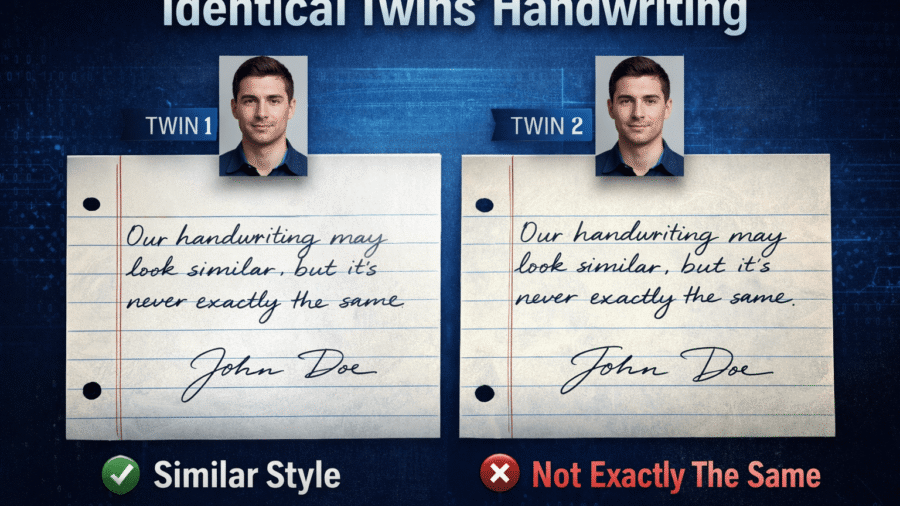
The concept of twin handwriting often raises an intriguing question: can identical twins have the same handwriting? Since identical twins share the same genetic makeup, many people assume their writing styles must also be identical. However, forensic science reveals a more complex reality.

In fact, forensic handwriting examination shows that while twins may develop similar writing patterns, their handwriting is never completely identical. Therefore, understanding the science behind twin handwriting becomes essential, especially in forensic investigations.

Understanding Twin Handwriting

Twin handwriting refers to the comparison of writing styles between identical or fraternal twins. Because identical twins share similar physical and neurological traits, their handwriting may appear alike at first glance.

However, handwriting is not determined by genetics alone. Instead, it develops through a combination of learning, environment, and individual motor habits. As a result, even identical twins develop subtle but detectable differences in their writing.

Why Twin Handwriting Looks Similar

There are several reasons why twin handwriting may appear similar:

1. Shared Learning Environment

Twins often attend the same schools and learn writing at the same time. Consequently, they receive similar instruction, which influences their writing style.

2. Similar Motor Skills

Because identical twins share genetic traits, their muscle coordination and fine motor skills may be alike. Therefore, their letter formation and writing rhythm can look similar.

3. Practice and Influence

Twins frequently observe and imitate each other. Over time, this mutual influence can lead to similar handwriting characteristics.

Why Twin Handwriting Is Never Identical

Despite these similarities, twin handwriting is never the same. Several factors contribute to these differences:

1. Individual Motor Development

Even minor differences in hand movement and muscle control create unique writing patterns.

2. Personal Habits

Each individual develops unique habits in spacing, pressure, and stroke sequence.

3. Natural Variations

Handwriting naturally varies every time a person writes. Therefore, exact duplication is impossible.

4. Psychological Factors

Mood, stress, and personality traits influence writing behavior. As a result, twins develop distinct writing styles over time.

Forensic Handwriting Examination in Twins

From a forensic perspective, analyzing twin handwriting can be challenging but not impossible. Experts rely on detailed examination techniques to identify differences.

Key Features Examined

  • Letter formation and structure
  • Writing pressure patterns
  • Spacing and alignment
  • Slant and stroke direction
  • Rhythm and writing speed

Even if two samples look similar, forensic experts focus on microscopic and behavioral details to distinguish between them.

Can Twins Copy Each Other’s Handwriting?

Yes, twins can attempt to imitate each other’s handwriting. However, even skilled imitation cannot perfectly replicate natural writing.

When someone copies handwriting, the result often shows signs such as the following:

  • Slow or hesitant strokes
  • Inconsistent pressure
  • Poor rhythm and flow

Therefore, forensic experts can usually detect imitation through detailed analysis.

Real-World Importance in Investigations

Twin handwriting analysis becomes particularly important in legal and criminal cases. For example:

  • Identifying the writer of anonymous notes
  • Verifying signatures in fraud cases
  • Distinguishing between suspects in investigations

In such cases, even small differences can play a crucial role in determining the truth.

Challenges in Twin Handwriting Analysis

High Similarity

The most significant challenge is the strong resemblance between writing styles, which may confuse initial observation.

Limited Samples

If only a few samples are available, distinguishing between twins becomes more difficult.

Intentional Disguise

Sometimes, individuals may intentionally alter their writing, adding complexity to the analysis.

Role of Technology

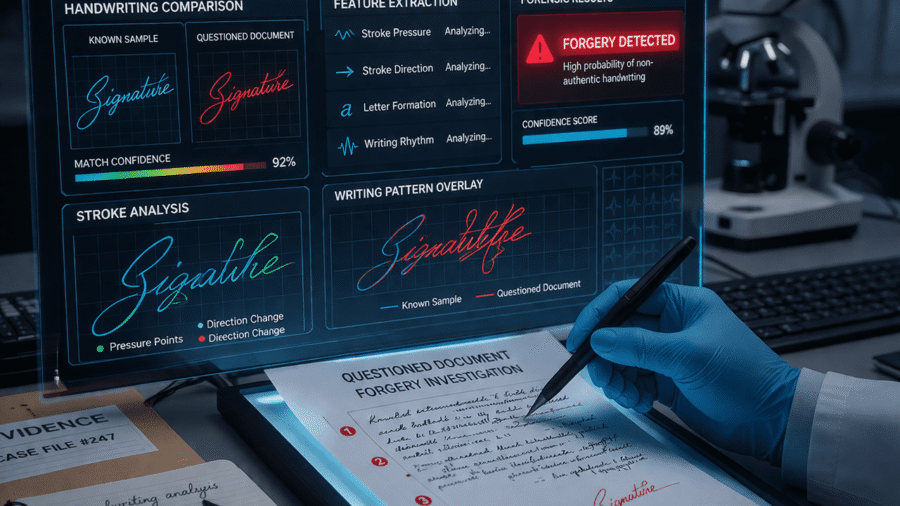
Modern technology has significantly improved handwriting analysis. Digital tools and AI-based systems help experts examine writing patterns with greater precision.

Additionally, software can analyze stroke patterns, pressure distribution, and writing dynamics. As a result, forensic experts can identify even subtle differences between twin handwriting samples.

Conclusion

Twin handwriting may appear strikingly similar, especially in the case of identical twins. However, no two individuals—even twins—can produce exactly identical handwriting.

Forensic handwriting examination proves that subtle differences always exist, and experts can identify them through detailed analysis. Ultimately, twin handwriting highlights the balance between genetic similarity and individual uniqueness, making it a fascinating subject in forensic science.

ChatGPT Image Mar 30, 2026, 12_03_48 PM

AI-Based Handwriting Analysis in Questioned Documents: The Future of Forensic Examination

Introduction

In today’s digital age, forensic science is evolving rapidly with the integration of artificial intelligence. As a result, AI handwriting analysis is transforming how experts examine questioned documents. Traditionally, handwriting examination relied heavily on manual comparison; however, modern AI tools now enhance accuracy and efficiency.

Moreover, the growing number of document fraud cases has made it essential to adopt advanced technologies for reliable analysis.

What is AI Handwriting Analysis?

AI handwriting analysis refers to the use of machine learning algorithms and computer vision techniques to examine and compare handwriting samples. In simple terms, it automates the process of identifying writing patterns and detecting inconsistencies.

Furthermore, these systems are trained on large datasets, enabling them to recognize subtle differences that may not be easily visible to the human eye.

Role in Questioned Document Examination

Questioned document examination involves verifying the authenticity of documents such as contracts, wills, signatures, and anonymous notes. In this context, AI plays a crucial role by providing objective and data-driven results.

For instance, AI tools can:

  • Compare handwriting samples instantly
  • Detect forged signatures
  • Analyze writing speed and pressure patterns
  • Identify disguised or altered writing

Therefore, AI significantly improves the reliability of forensic conclusions.

Key Technologies Behind AI Handwriting Analysis

Machine Learning Algorithms

First of all, machine learning models are trained to recognize handwriting features such as stroke patterns and letter formation. These models continuously improve as more data is processed.

Computer Vision

Next, computer vision enables systems to analyze images of handwritten text. It detects shapes, spacing, and alignment with high precision.

Pattern Recognition

Additionally, AI identifies recurring patterns in handwriting. As a result, it becomes easier to distinguish between genuine and forged writing.

Neural Networks

Finally, deep learning models, especially neural networks, simulate human brain functions to analyze complex handwriting traits.

Advantages of AI in Handwriting Analysis

AI offers several benefits in forensic document examination:

  • Higher accuracy: Reduces human error
  • Speed: Processes large datasets quickly
  • Consistency: Provides standardized results
  • Scalability: Handles multiple cases efficiently

Moreover, AI can work alongside human experts, enhancing decision-making rather than replacing it.

Challenges and Limitations

Despite its advantages, AI handwriting analysis faces certain challenges:

Data Quality

On one hand, AI systems require high-quality datasets for training. Poor data can affect accuracy.

Variability in Handwriting

On the other hand, natural variations in handwriting can make analysis complex.

Ethical Concerns

Additionally, issues related to data privacy and misuse of AI must be addressed.

Legal Acceptance

Furthermore, courts may require validation before accepting AI-generated results as evidence.

Applications in Real-World Investigations

AI handwriting analysis is widely used in various fields:

  • Criminal investigations
  • Fraud detection
  • Banking and financial verification
  • Historical document authentication

For example, it helps detect forged signatures in financial transactions and verify legal documents.

Future of AI in Questioned Documents

Looking ahead, AI is expected to play an even bigger role in forensic science. Innovations such as real-time handwriting verification and integration with biometric systems are on the rise.

Consequently, the combination of AI and forensic expertise will lead to more accurate and efficient investigations.

Conclusion

To sum up, AI handwriting analysis is revolutionizing questioned document examination. Combining advanced algorithms with forensic expertise enhances accuracy, speed, and reliability.

Ultimately, as technology continues to evolve, AI will become a vital tool for detecting forgery and ensuring document authenticity.

ChatGPT Image Mar 27, 2026, 11_51_34 AM

Forensic Handwriting Examination: Detecting Truth in Documents

Forensic Handwriting Examination: Detecting Truth in Documents

In the world of forensic science, documents often hold critical evidence. From legal contracts to handwritten notes, every stroke of a pen can reveal important clues. Forensic handwriting examination plays a vital role in uncovering the truth behind such documents. It helps experts determine authenticity, identify writers, and detect forgery.

Therefore, this field is essential in both criminal investigations and civil disputes.

What is forensic handwriting examination?

Forensic handwriting examination, also known as questioned document examination, involves the scientific analysis of handwriting to verify its authenticity. Experts study various characteristics of writing to determine whether a document is genuine or forged.

In simple terms, it is the process of comparing known handwriting samples with questioned documents to detect similarities or differences.

Key Principles of Handwriting Analysis

Handwriting is considered unique to each individual. However, it is not completely unchangeable. Experts rely on certain principles while conducting handwriting analysis in forensics:

  • Individuality: No two people write the same
  • Natural variation: A person’s handwriting may vary slightly over time
  • Consistency: Genuine writing shows consistent patterns

Thus, examiners look for a combination of similarities and natural variations rather than exact matches.

Techniques Used in Forensic Handwriting Examination

Experts use various scientific techniques to analyze handwriting. Moreover, these methods ensure accuracy and reliability.

1. Visual Examination

Initially, examiners study the document using the naked eye or magnification tools. They analyze:

  • Letter shapes and formations
  • Spacing between words and letters
  • Writing speed and pressure

2. Microscopic Analysis

Additionally, microscopes help identify fine details such as ink flow, pen lifts, and stroke order.

3. Digital Analysis

Modern technology allows experts to use software for precise comparisons. Consequently, experts can detect even subtle differences.

4. Signature Verification

Signatures are one of the most commonly examined elements. Therefore, signature verification is crucial in financial and legal fraud cases.

Detecting Forgery in Documents

Forgery is one of the primary concerns in document examination. However, detecting forgery is not always straightforward. There are different types of forgery:

🔹 Simple Forgery

The forger writes a name without trying to imitate the original handwriting.

🔹 Simulated Forgery

The forger attempts to copy someone else’s handwriting or signature.

🔹 Traced Forgery

The original writing is traced to create a duplicate.

In each case, forensic experts analyze inconsistencies such as unnatural pen pressure, slow writing, and tremors. Consequently, these signs help in detecting forgery in documents.

Applications in Real-World Cases

Forensic handwriting examination is widely used in various scenarios. For example:

  • Legal disputes: Verifying wills, contracts, and agreements
  • Financial fraud: Detecting forged signatures on checks or documents
  • Criminal cases: Identifying anonymous letters or threat notes
  • Historical investigations: Authenticating old manuscripts

As a result, this field plays a crucial role in delivering justice.

 Challenges in Handwriting Examination

Despite its importance, forensic handwriting examination comes with challenges. Firstly, handwriting can change due to age, illness, or emotional state. Secondly, skilled forgers may imitate writing convincingly.

  • Limited or poor-quality samples
  • Intentional disguise of handwriting
  • Lack of sufficient comparison material

Nevertheless, trained experts can still reach reliable conclusions using scientific methods.

Importance in Forensic Science

Understanding forensic handwriting examination is essential because it helps uncover hidden truths. Moreover, it provides valuable evidence in courts and investigations.

  • Supports criminal investigations
  • Strengthens legal arguments
  • Helps prevent fraud

Therefore, handwriting analysis remains a powerful tool in forensic science.

Future of Handwriting Examination

With advancements in technology, handwriting analysis is evolving. For instance, we are using artificial intelligence and machine learning to enhance accuracy.

  • AI-based handwriting recognition
  • Digital forensic tools
  • Improved imaging techniques

As a result, the future of handwriting analysis in forensics looks more precise and reliable than ever.

 Conclusion

Forensic handwriting examination is a fascinating and essential branch of forensic science. In conclusion, it helps detect truth in documents by analyzing writing patterns, identifying inconsistencies, and exposing forgery.

Ultimately, whether it is a disputed signature or an anonymous note, handwriting analysis plays a key role in uncovering the truth and ensuring justice.

ChatGPT Image Mar 25, 2026, 11_54_44 AM

The Psychology Behind Handwriting in Forensic Analysis

Introduction

Handwriting is more than just a means of communication—it is a unique expression of an individual’s cognitive and motor processes. In forensic investigations, handwriting analysis plays a crucial role in identifying authorship, detecting forgery, and understanding behavioral patterns. The psychology behind handwriting in forensic analysis provides valuable insights into how personality traits, habits, and mental states influence writing styles.

Therefore, combining psychology with forensic handwriting analysis enhances the accuracy and reliability of document examination, making it a powerful tool in criminal investigations.

Understanding Handwriting as Behavior

Handwriting is considered a neuromuscular activity that reflects coordination between the brain and hand movements. In other words, every stroke, curve, and spacing pattern is influenced by the writer’s psychological and physiological state.

For example, factors such as stress, fatigue, or emotional instability can affect handwriting consistency. As a result, forensic experts carefully examine these variations to determine whether a document is genuine or altered.

Moreover, handwriting is highly individualized. Even when people attempt to imitate someone else’s writing, subtle differences often remain. These differences are key in forensic handwriting analysis.

The Role of Psychology in Handwriting Analysis

Psychology plays a significant role in understanding why handwriting varies from person to person. In particular, it helps explain the underlying behavioral patterns that influence writing style.

Personality and Writing Style

Certain handwriting characteristics are often linked to personality traits. For instance:

  • Large letters may indicate confidence or extroversion
  • Small writing may suggest focus and introversion
  • Heavy pressure can reflect strong emotions or determination

However, it is important to note that forensic handwriting analysis does not rely solely on personality interpretation. Instead, it focuses on identifying consistent patterns that can link a document to a specific individual.

Habit Formation

Handwriting habits develop over time and become automatic. Therefore, even under pressure or when attempting to disguise writing, individuals tend to repeat certain patterns such as letter formations, spacing, and slant.

These habitual traits are critical in forensic handwriting analysis, as they provide reliable markers for identification.

Handwriting and Forgery Detection

One of the primary applications of handwriting forensics is detecting forgery. In many cases, forged documents attempt to replicate the appearance of genuine writing. However, psychological factors often make perfect imitation difficult.

Types of Forgery

  • Freehand forgery—Attempting to copy a signature without tracing
  • Traced forgery—Directly tracing over an original signature
  • Disguised writing—Altering one’s own handwriting intentionally

Each type of forgery introduces inconsistencies. For example, hesitation marks, unnatural pen lifts, and irregular pressure patterns can indicate a forged document.

Psychological Pressure in Forgery

Forgers often experience anxiety and overthinking while copying handwriting. As a result, their writing may appear slow, shaky, or inconsistent. These psychological cues help forensic experts identify suspicious documents.

Key Features Analyzed in Forensic Handwriting

Forensic handwriting analysis involves examining multiple features to establish authenticity:

  • Letter formation – Shape and structure of individual letters
  • Spacing – Distance between words and letters
  • Slant – Direction of writing (left, right, or vertical)
  • Pressure patterns – Light or heavy strokes
  • Baseline alignment – Consistency in writing along a line

By analyzing these elements, experts can detect patterns and identify discrepancies between genuine and questioned documents.

Limitations of Psychological Interpretation

While psychology provides valuable insights, it has limitations in forensic handwriting analysis. For instance, handwriting alone cannot definitively determine a person’s personality or mental state.

Additionally, external factors such as writing tools, surface, and environmental conditions can influence handwriting. Therefore, forensic experts must rely on scientific methods and comparative analysis rather than subjective interpretations.

Importance in Legal Investigations

Handwriting forensics plays a vital role in legal cases involving fraud, identity theft, and disputed documents. In such situations, expert analysis can provide critical evidence in court.

However, the credibility of handwriting analysis depends on proper methodology, documentation, and expert testimony. Thus, maintaining objectivity and following standardized procedures is essential.

Future of Handwriting Analysis

With advancements in technology, forensic handwriting analysis is evolving. For example, digital tools and artificial intelligence are being used to analyze handwriting patterns more efficiently.

Nevertheless, human expertise remains indispensable. Because psychological nuances and contextual interpretation require professional judgment, experts will continue to play a central role in this field.

Conclusion

The psychology behind handwriting in forensic analysis offers a deeper understanding of how behavior and cognition influence writing. Ultimately, handwriting analysis is not just about comparing letters—it is about identifying patterns shaped by human psychology.

By integrating psychological insights with scientific techniques, forensic experts can detect forgery, verify authenticity, and support legal investigations. Therefore, handwriting forensics remains an essential component of modern forensic science.