

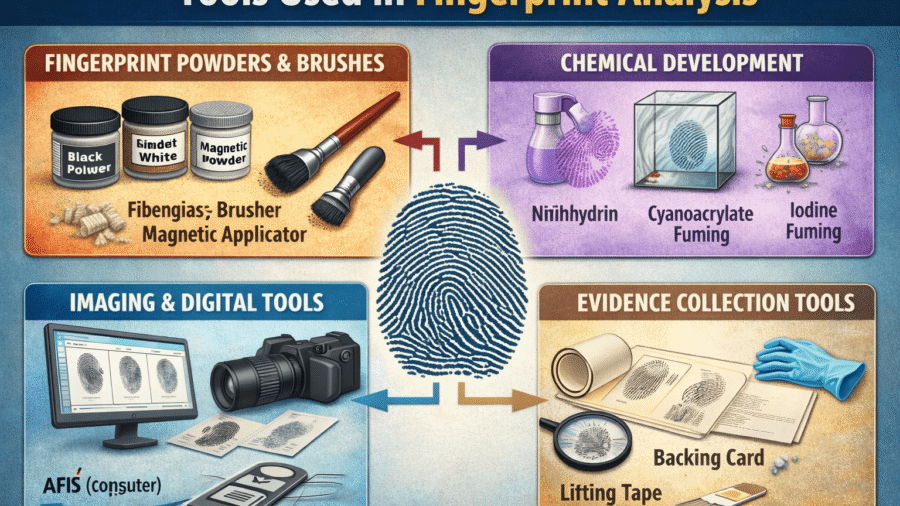
Fingerprint analysis is one of the most reliable methods of identification in forensic science. However, accurate results depend heavily on the tools and equipment used in fingerprint analysis. From crime scene investigation to laboratory examination, forensic experts rely on specialized instruments to detect, develop, and analyze fingerprints.
Therefore, understanding fingerprint analysis equipment is essential for anyone involved in forensic investigations.
Importance of Tools in Fingerprint Analysis
The success of tools for latent fingerprint analysis depends on selecting the right method for each situation. For instance, different surfaces and environmental conditions require different tools.
- Proper tools improve accuracy
- Moreover, they help preserve delicate evidence
- Additionally, they enhance the visibility of latent prints
Thus, forensic fingerprint tools play a crucial role in solving criminal cases.
Basic Tools Used in Fingerprint Analysis
Fingerprint Powders
Fingerprint powders are among the most common tools used in fingerprint analysis. They help visualise latent prints on non-porous surfaces.
- Black powder for light surfaces
- White or aluminium powder for dark surfaces
- Magnetic powder for delicate prints
As a result, powders make invisible fingerprints visible.
Brushes for Powder Application
Brushes are used to apply fingerprint powder carefully. However, improper use can damage prints.
- Fiberglass brushes
- Feather brushes
- Magnetic applicators
Therefore, skilled handling is essential to avoid distortion.
Chemical Equipment for Fingerprint Development
Chemical methods are used when powders are not effective. In particular, they are useful for porous surfaces like paper.
Ninhydrin
Ninhydrin reacts with amino acids in sweat to produce a purple colour.
Consequently, it is widely used in forensic laboratories.
Cyanoacrylate (Super Glue Fuming)
This method is used for non-porous surfaces. When heated, the fumes adhere to fingerprint residue, making it visible.
Moreover, this technique is highly effective for plastic, glass, and metal surfaces.
Iodine Fuming
Iodine vapors temporarily develop fingerprints. However, the prints fade quickly, so they must be photographed immediately.
Optical and Imaging Tools
Modern fingerprint analysis relies heavily on optical tools. These tools improve detection and documentation.
Magnifying Glass and Microscopes
- Help examine fine ridge details
- Additionally, assist in identifying minute points
Alternate Light Sources (ALS)
ALS uses different wavelengths of light to reveal hidden prints.
For example, UV light can make latent prints more visible.
Digital Cameras
High-resolution cameras are used to capture fingerprint images.
Therefore, proper documentation is ensured for court presentation.
Digital Fingerprint Analysis Equipment
Technology has revolutionised fingerprint examination techniques. As a result, digital tools are now widely used.
AFIS (Automated Fingerprint Identification System)
AFIS is a computerised system that matches fingerprints with large databases.
- Fast comparison of prints
- Moreover, reduces manual effort
- High accuracy in identification
Fingerprint Analysis Software
Advanced software helps enhance and compare prints.
- Image enhancement
- Pattern recognition
- Automated matching
Thus, digital tools improve efficiency and reliability.
Evidence Collection and Preservation Tools
Collecting fingerprints properly is just as important as analyzing them. Therefore, specialized tools are used for preservation.
Lifting Tapes
- Used to lift developed fingerprints
- Preserve prints for further analysis
Backing Cards
- Provide contrast and support
- Help in storing lifted prints
Gloves and Protective Gear
- Prevent contamination
- Ensure evidence integrity
Consequently, proper handling ensures reliable results.
Challenges in Using Fingerprint Tools
Despite advanced tools, challenges still exist. For example:
- Improper tool selection
- Environmental interference
- Human error
However, trained professionals can overcome these issues with experience and proper techniques.
Future of Fingerprint Analysis Equipment
The future of fingerprint analysis equipment is driven by innovation. For instance, AI and machine learning are improving accuracy.
- AI-based fingerprint recognition
- Portable scanning devices
- 3D fingerprint analysis
As a result, forensic investigations are becoming faster and more precise.
Conclusion
Tools and equipment used in fingerprint analysis are essential for accurate identification. From powders and chemicals to advanced digital systems, each tool plays a vital role.
In conclusion, understanding forensic fingerprint tools helps improve analysis, preserve evidence, and ensure justice. As technology advances, fingerprint examination techniques will continue to evolve, making forensic science more reliable than ever.
