

Handwriting is a unique human trait that reflects motor skills, habits, and learned patterns. However, a common question remains—can handwriting predict personality? Many people believe that the way we write reveals hidden aspects of our character. This idea forms the basis of personality studies in handwriting analysis, also known as graphology.
Therefore, it is important to separate scientific facts from popular myths when discussing handwriting and personality.
What is graphology?
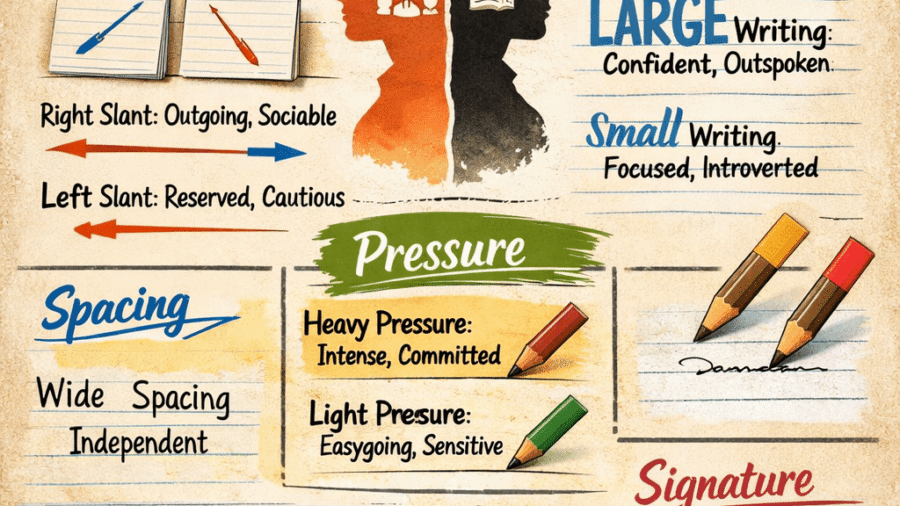
Graphology is the study of handwriting aimed at identifying personality traits. In simple terms, graphology suggests that handwriting reflects psychological characteristics. For example, analysts examine slant, spacing, size, and pressure to interpret behavior.
Moreover, graphology is widely used in non-forensic fields, such as recruitment and personal assessments. However, its scientific reliability remains debated.
How Handwriting is Linked to Personality
Supporters of handwriting analysis believe that certain features of handwriting indicate specific personality traits. For instance:
- Large handwriting may indicate confidence and extroversion
- Small handwriting may suggest focus and introversion
- The right slant may reflect emotional expressiveness
- Heavy pressure may indicate strong emotions or determination
Thus, handwriting is often interpreted as a mirror of inner behavior.
Scientific Perspective: Myth or Reality?
While graphology sounds intriguing, scientific research does not strongly support the idea that handwriting can predict personality accurately. Most psychologists consider it a pseudoscience.
- Lack of consistent empirical evidence
- Results vary between analysts
- Interpretations can be subjective
However, handwriting can still reveal certain physical and neurological aspects, such as motor control or health conditions.
Handwriting in Forensic Science
In forensic science, handwriting analysis serves a very different purpose. Experts focus on identification, not personality.
- Verifying signatures
- Detecting forgery
- Comparing writing samples
Therefore, graphology in forensic science is not used to assess personality, but rather to establish authenticity and identity.
Common Myths About Handwriting and Personality
Many myths surround the idea of personality prediction through handwriting. Let’s clarify a few:
Myth 1: Handwriting reveals exact personality traits
Reality: It may suggest tendencies but not definitive traits.
Myth 2: Graphology is scientifically proven
Reality: It lacks strong scientific validation.
Myth 3: Handwriting never changes
Reality: It changes with age, mood, and conditions.
Thus, relying solely on handwriting for personality assessment can be misleading.
What Handwriting Can Actually Reveal
Although handwriting cannot reliably predict personality, it can still provide useful insights.
- Writing speed may reflect motor coordination
- Pressure may indicate physical energy
- Consistency may reflect practice and habit
In addition, sudden changes in handwriting may indicate stress or health issues.
Modern Alternatives to Personality Analysis
Today, psychologists rely on more reliable methods to assess personality. For example:
- Psychometric tests
- Behavioral analysis
- Structured interviews
As a result, these methods provide more accurate and scientifically validated insights compared to handwriting analysis.
Should You Trust Handwriting Analysis?
Handwriting analysis can be intriguing and sometimes insightful. However, it should not be considered a scientifically reliable method for predicting personality.
Instead, it is best viewed as a supplementary or interpretive tool rather than a definitive assessment.
Conclusion
Therefore can handwriting predict personality? The answer is not entirely. While handwriting may reflect certain habits or tendencies, it cannot accurately determine personality traits. Scientific evidence does not strongly support graphology as a reliable method.
In conclusion, handwriting analysis is valuable in forensic identification but limited in personality prediction. Therefore, it is important to approach such claims with caution and rely on scientifically proven methods for accurate personality assessment.
