

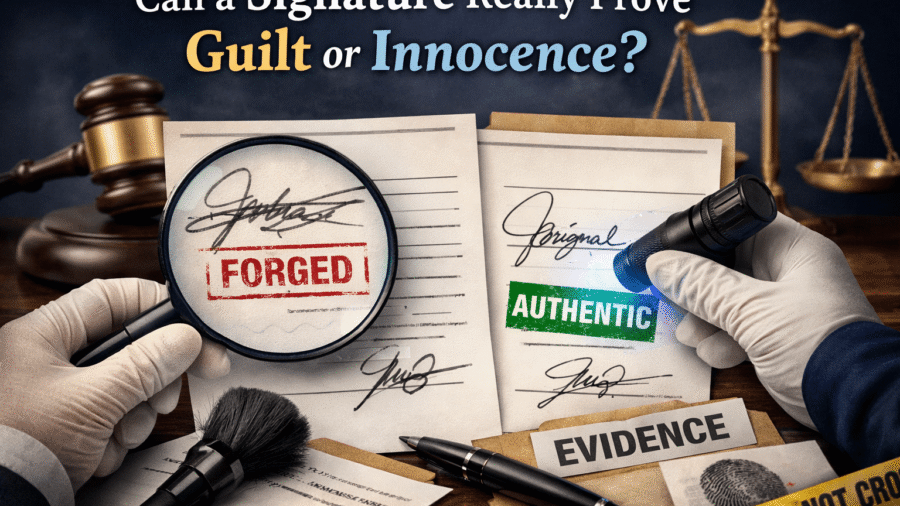
Can a Signature Really Prove Guilt or Innocence?
In legal and forensic investigations, a signature often plays a decisive role. Authorities use signatures in property disputes, banking frauds, wills, contracts, and financial agreements. As a result, people frequently assume that a signature alone can establish guilt or innocence. However, this assumption oversimplifies a complex forensic reality. A signature does not automatically prove guilt or innocence unless scientific examination supports it.
To understand why, one must examine how signatures function as evidence and how forensic experts analyze them.
The Legal Weight of a Signature
Legally, a signature signifies consent, authorization, or acknowledgment. Courts rely on signatures to determine whether an individual accepted obligations or approved transactions. Therefore, when a dispute arises, the authenticity of the signature becomes critical.
However, the law does not treat signatures as infallible proof. Instead, courts recognize that signatures can be forged, altered, or obtained under questionable circumstances. Consequently, the legal system depends on forensic science to assess disputed signatures objectively.
Why a Signature Alone Is Not Conclusive
Many people believe that signatures remain consistent throughout a person’s life. In reality, natural variation exists in every genuine signature. Factors such as health, writing speed, emotional state, pen type, and writing surface influence how a person signs.
Because of these variations:
-
Genuine signatures may appear different
-
Forged signatures may look similar
-
Visual comparison alone becomes unreliable
Therefore, investigators should never rely solely on appearance. Instead, they must seek expert forensic analysis to avoid wrongful conclusions.
Role of Forensic Signature Examination
Forensic handwriting examination focuses on the process of writing, not just the final appearance. A trained Questioned Document Examiner studies writing habits that develop subconsciously over time.
Specifically, examiners analyze:
-
Stroke order and direction
-
Line quality and fluency
-
Pen pressure patterns
-
Rhythm, spacing, and proportions
-
Natural variations versus unnatural features
Moreover, genuine signatures usually show smooth movement and rhythm. In contrast, forged signatures often reveal hesitation, tremors, patching, or blunt starts and stops. As a result, scientific examination helps differentiate genuine writing from imitation.
Common Types of Signature Forgery
Understanding forgery types further explains why a signature alone cannot decide guilt.
First, freehand forgeries involve imitation by practice. Although these may appear convincing, they often lack natural fluency.
Second, traced forgeries occur when someone traces an original signature. These usually show slow movement, hesitation, and uneven pressure.
Third, simulated forgeries attempt to mimic speed and confidence. However, they frequently miss individual writing habits.
Each forgery type requires careful analysis. Therefore, experts rely on microscopic examination and comparison rather than assumption.
Importance of Comparison Standards
A forensic opinion depends heavily on standard signatures, which represent known genuine writing of the individual. Ideally, these standards should:
-
Originate from the same time period
-
Appear on similar documents
-
Exist in sufficient quantity
Without adequate standards, an examiner cannot reach a definitive conclusion. Consequently, experts may issue qualified or limited opinions. This limitation further reinforces that a signature alone cannot conclusively prove anything.
Signature as Supporting Evidence
In most cases, a signature functions as supporting evidence, not independent proof. Investigators and courts usually evaluate signatures alongside:
-
Witness statements
-
Circumstantial evidence
-
Digital records
-
Financial or transactional data
For example, a forged signature may suggest fraud. However, guilt requires proof of intent, benefit, and involvement. Similarly, a genuine signature does not always indicate guilt. Coercion, deception, or misunderstanding may still exist.
Therefore, courts examine the entire evidentiary framework, not just the signature.
Limitations of Signature Examination
Although forensic signature examination is reliable, it has limitations. Poor-quality photocopies, scanned documents, or distorted images can restrict analysis. In addition, deliberate disguise by the genuine writer can complicate interpretation.
Furthermore, long time gaps between questioned and standard signatures may affect comparison. Ethical examiners clearly disclose these limitations to ensure transparency and fairness.
Conclusion: Evidence Over Assumption
So, can a signature really prove guilt or innocence?
The answer remains clear: not on its own.
A signature gains evidentiary value only when forensic experts examine it scientifically and interpret it alongside other evidence. Forensic document examination replaces assumption with method and opinion with analysis.
Ultimately, justice relies not on how a signature looks, but on how the evidence speaks when science listens carefully.