
ChatGPT Image Feb 26, 2026, 12_18_40 PM

Fingerprint Development on Porous vs Non-Porous Surfaces

Fingerprint Development on Porous vs Non-Porous Surfaces

Fingerprint evidence plays a crucial role in forensic identification. However, the success of fingerprint examination depends heavily on the surface that receives the print. Therefore, forensic experts must understand how porous and non-porous surfaces interact with fingerprint residues. Moreover, choosing the wrong development method can permanently destroy valuable evidence. As a result, proper surface assessment becomes essential at both crime scenes and forensic laboratories.

Understanding Latent Fingerprints

Human skin constantly secretes sweat and oils. Consequently, every touch leaves behind residues containing water, amino acids, and lipids. When individuals touch an object, these substances form latent fingerprints that remain invisible to the naked eye. Thus, forensic experts rely on scientific development techniques to visualize ridge patterns without damaging the evidence.

Porous Surfaces and Their Characteristics

Porous surfaces absorb fingerprint residues into their structure. Common examples include paper, cardboard, fabric, envelopes, currency notes, and untreated wood. Because these materials absorb moisture and oils, fingerprint powders fail to produce reliable results.

Therefore, forensic examiners select chemical development methods for porous surfaces. Importantly, these methods react with fingerprint constituents that remain trapped within the material.

Fingerprint Development Techniques for Porous Surfaces

Ninhydrin Method

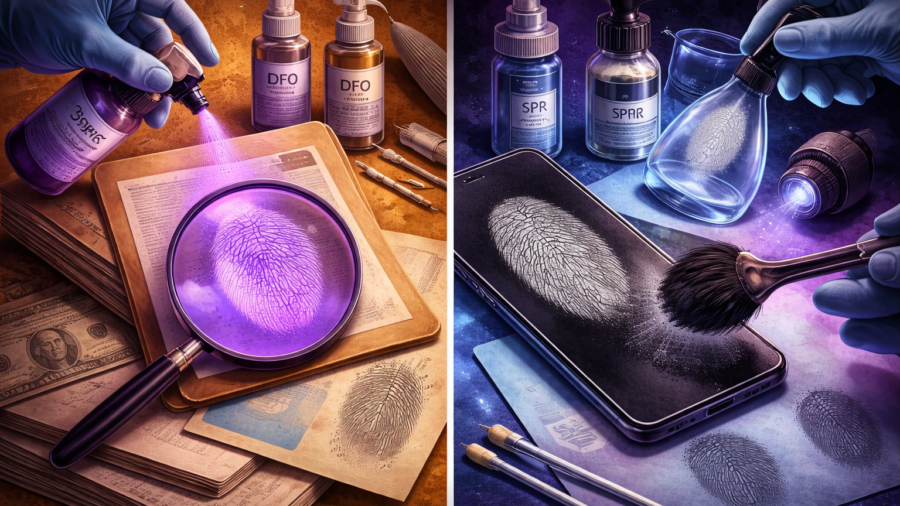
Forensic analysts frequently use ninhydrin to develop fingerprints on porous materials. This chemical reacts with amino acids present in sweat and produces a purple coloration known as Ruhemann’s purple. Moreover, investigators prefer ninhydrin for older prints because amino acids remain stable over time.

However, excessive heat and humidity can reduce effectiveness. Thus, examiners control environmental conditions carefully during processing.

DFO (1,8-Diazafluoren-9-one)

Experts often apply DFO when fluorescence enhances visibility. Under forensic light sources, developed fingerprints emit strong fluorescence. As a result, examiners detect faint ridge details on low-contrast backgrounds more easily.

Silver Nitrate

Forensic specialists use silver nitrate selectively. This reagent reacts with chloride ions in sweat to form silver chloride. When exposed to light, the compound darkens and reveals ridge patterns. Nevertheless, this method permanently alters the surface. Therefore, experts reserve it as a last option.

Non-Porous Surfaces and Their Characteristics

Non-porous surfaces do not absorb fingerprint residues. Instead, residues remain on the surface. Examples include glass, plastic, metal, painted objects, glossy packaging, and mobile phone screens. Because residue remains accessible, forensic experts often achieve faster results on these surfaces.

Fingerprint Development Techniques for Non-Porous Surfaces

Powder Dusting

Crime scene investigators commonly use powder dusting on non-porous surfaces. Powders adhere to moisture and oils present in fingerprint residues and reveal ridge patterns. However, examiners must apply powder gently. Excessive brushing smears prints and reduces evidentiary value.

Cyanoacrylate (Super Glue) Fuming

Forensic laboratories widely use cyanoacrylate fuming. During this process, heated glue releases fumes that bond with fingerprint residues. Consequently, a white, stable fingerprint forms on the surface. Moreover, examiners often enhance these prints with fluorescent dyes for improved clarity.

Small Particle Reagent (SPR)

Investigators rely on SPR for wet non-porous surfaces. This method targets lipid components that survive water exposure. Therefore, SPR proves effective for submerged or rain-exposed evidence.

Key Differences in Development Strategy

Importantly, porous and non-porous surfaces require different forensic approaches. While porous surfaces trap fingerprint residues internally, non-porous surfaces retain residues externally. As a result, examiners must choose chemical reactions for porous materials and physical or polymer-based methods for non-porous objects.

Furthermore, porous surface techniques often take longer to process. In contrast, non-porous methods provide quicker visual results but demand careful handling.

Common Challenges in Fingerprint Development

Despite advanced techniques, forensic experts face several challenges. Environmental factors such as heat, humidity, and sunlight degrade residues. Additionally, surface contamination and improper evidence handling reduce recovery chances. Therefore, trained examiners and methodical procedures remain essential.

Legal Importance of Correct Development

Courts expect forensic experts to follow scientifically accepted methods. Thus, examiners must document each step carefully. Moreover, proper development strengthens admissibility and withstands cross-examination. Ultimately, reliable fingerprint evidence enhances investigative credibility.

Conclusion

In conclusion, fingerprint development on porous and non-porous surfaces demands surface-specific forensic strategies. Although the objective remains the same, examiners must adjust techniques according to material properties. Ultimately, the expertise of the fingerprint examiner determines whether latent prints become decisive evidence or lost opportunities in forensic investigations.
ChatGPT Image Feb 21, 2026, 10_12_15 AM

Methods of Developing Latent Fingerprints: Powder, Chemical & Optical Techniques

Methods of Developing Latent Fingerprints: Powder, Chemical & Optical Techniques

Latent fingerprints play a vital role in forensic investigations because they often provide direct physical evidence linking a suspect to a crime scene. However, unlike patent fingerprints, latent prints are invisible to the naked eye. Therefore, forensic experts must use scientific methods to develop and visualize these hidden impressions without damaging the evidence. Over the years, several reliable techniques have been developed, broadly classified into powder, chemical, and optical methods. Each technique is chosen based on the surface, environmental conditions, and the nature of the evidence.

Understanding Latent Fingerprints

Latent fingerprints are formed when natural secretions from the skin—such as sweat, oils, and amino acids—are transferred onto a surface. Since these residues are usually colorless, they remain unnoticed until properly developed. Consequently, the success of fingerprint development depends on selecting the correct method and applying it carefully.

Powder Techniques for Latent Fingerprint Development

Powder methods are among the oldest and most commonly used techniques for developing latent fingerprints. They are simple, cost-effective, and ideal for non-porous surfaces.

How Powder Methods Work

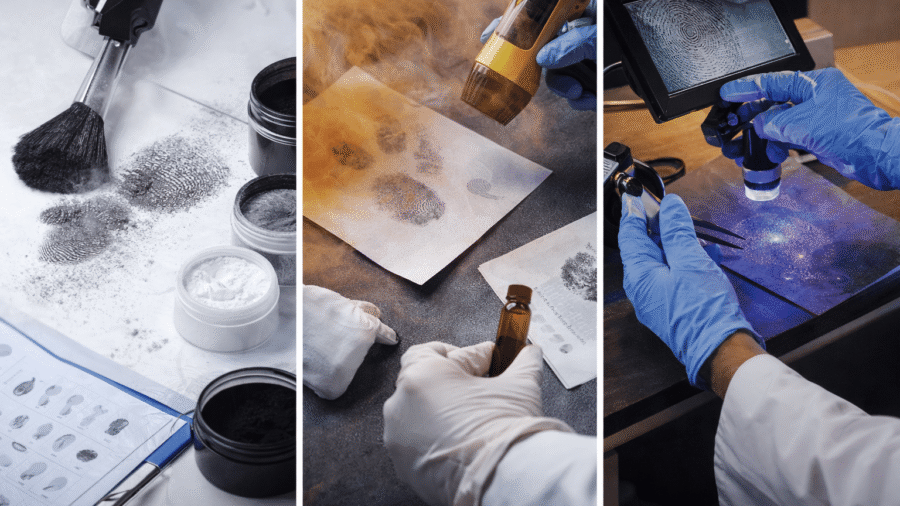
Fingerprint powders adhere to the moisture and oily components present in latent prints. As a result, ridge patterns become visible and can be photographed or lifted.

Types of Fingerprint Powders

  • Black powder: Used on light-colored surfaces such as paper or plastic.

  • White powder: Suitable for dark surfaces like glass or metal.

  • Gray powder: Preferred for multicolored or reflective surfaces.

  • Magnetic powder: Applied using a magnetic applicator, reducing surface damage.

Advantages and Limitations

Powder techniques are quick and easy to apply. Moreover, they work well on smooth surfaces such as glass, mirrors, and polished metals. However, they are not suitable for porous surfaces. Additionally, excessive brushing may damage fragile ridge details, making expert handling essential.

Chemical Techniques for Latent Fingerprint Development

When fingerprints are present on porous or semi-porous surfaces, chemical methods provide better results. These techniques react chemically with fingerprint residues to produce visible impressions.

Ninhydrin Method

Ninhydrin reacts with amino acids in sweat to form a purple or blue-colored compound. Therefore, it is widely used on paper, cardboard, and documents. Since the reaction develops slowly, heat and humidity are often applied to accelerate results.

Iodine Fuming

Iodine fumes temporarily adhere to fatty components of fingerprints, producing a brown image. This method is quick and non-destructive. However, because the prints fade rapidly, immediate photography is required.

Silver Nitrate

Silver nitrate reacts with chloride ions present in sweat, forming silver chloride, which turns dark under light exposure. Consequently, it is useful for old or water-exposed paper evidence. However, it permanently stains the surface and is usually considered a last-resort technique.

Cyanoacrylate (Super Glue) Fuming

Cyanoacrylate vapors polymerize on fingerprint residues, creating a white, stable print. This technique works exceptionally well on non-porous surfaces such as plastics and metals. Moreover, developed prints can be further enhanced using powders or fluorescent dyes.

Optical Techniques for Latent Fingerprint Development

Optical methods rely on light rather than chemicals or powders. These techniques are especially useful when evidence must remain untouched.

Alternate Light Sources (ALS)

Alternate light sources use ultraviolet or blue light to cause fingerprint residues to fluoresce. As a result, prints become visible when viewed through appropriate filters. This method is non-destructive and highly effective on multicolored surfaces.

Laser Illumination

Lasers provide high-intensity light that enhances weak or aged fingerprints. Although highly effective, this technique requires specialized equipment and trained personnel.

Digital Enhancement

Modern forensic laboratories use digital imaging software to enhance faint fingerprints. By adjusting contrast, brightness, and color balance, experts can improve ridge clarity without altering the original evidence.

Choosing the Right Technique

Selecting the appropriate fingerprint development method is crucial. Therefore, forensic examiners consider several factors, including surface type, environmental exposure, age of the print, and case requirements. Often, investigators use multiple techniques sequentially to maximize results. However, improper selection or careless application can permanently destroy valuable evidence.

Importance in Court Proceedings

Developed latent fingerprints often serve as critical evidence in criminal trials. Consequently, courts closely examine the methods used for development. Proper documentation, adherence to standard protocols, and expert interpretation ensure that fingerprint evidence remains admissible and reliable.

Conclusion

Latent fingerprint development is both a scientific and skill-based process. Powder techniques offer simplicity, chemical methods provide depth and permanence, and optical techniques ensure non-destructive visualization. Therefore, understanding these methods is essential for forensic students, investigators, and experts alike. When applied correctly, these techniques transform invisible marks into powerful forensic evidence that can support justice.