
Fingerprint Distortion: Causes and Impact on Identification
Fingerprint evidence is one of the most reliable forms of identification in forensic science. However, fingerprints are not always perfect when recovered from a crime scene. Often, they appear altered or unclear due to various factors. This phenomenon is known as fingerprint distortion, and it can significantly affect the accuracy of identification.
Therefore, understanding fingerprint distortion is essential for forensic experts performing latent fingerprint analysis.
What is Fingerprint Distortion?
Fingerprint distortion refers to any alteration in the natural ridge pattern of a fingerprint. In simple terms, it occurs when the fingerprint does not accurately reflect the true pattern of the finger.
Moreover, distortion can happen during deposition, development, or even during the analysis process. As a result, it becomes challenging to match prints accurately.
Causes of Fingerprint Distortion
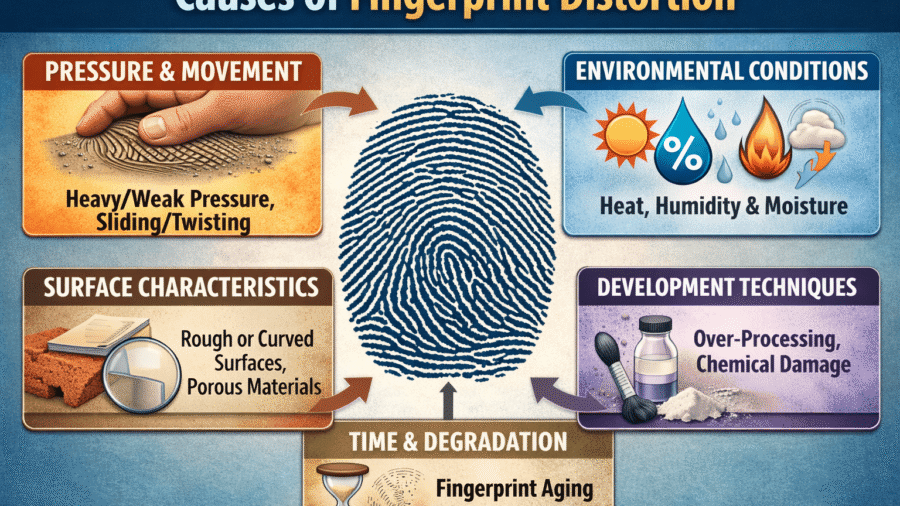
There are several causes of fingerprint distortion, and they can be broadly categorised into physical, environmental, and procedural factors.
1. Pressure and Movement During Deposition
One of the most common causes of fingerprint distortion is the way a finger touches a surface. For instance, excessive pressure can flatten the ridges, while insufficient pressure may result in incomplete prints.
- Heavy pressure causes ridge spreading
- Light pressure leads to partial prints
- Movement or sliding creates smudged or stretched patterns
Consequently, such distortions can make comparison more difficult.
2. Environmental Conditions
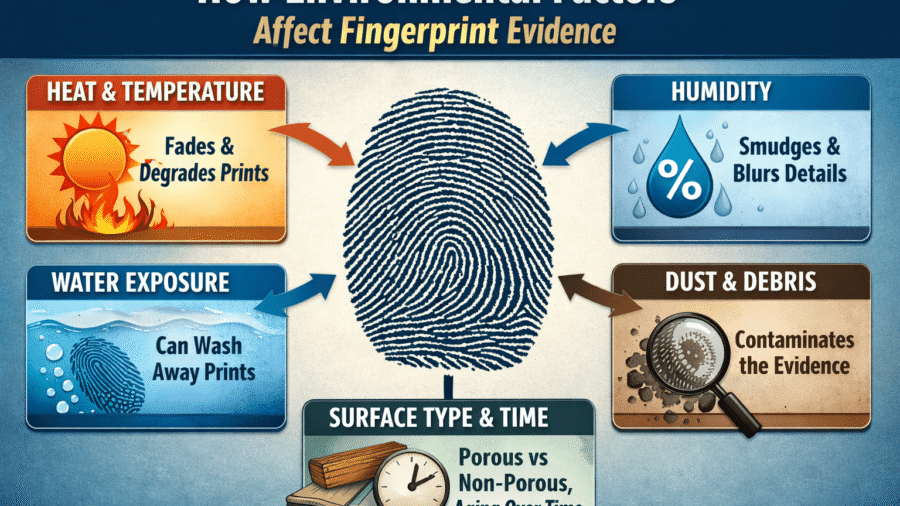
Environmental factors also play a significant role. For example, heat, humidity, and moisture can alter fingerprint residue.
- High temperatures can degrade sweat and oils
- Humidity may blur ridge details
- Water exposure can distort or wash away prints
Consequently, forensic experts frequently encounter distorted fingerprints in outdoor or uncontrolled environments.
3. Surface Characteristics
The type of surface on which a fingerprint is deposited greatly influences distortion. Generally, uneven or textured surfaces create more distortion.
- Rough surfaces break ridge continuity
- Curved surfaces stretch the pattern
- Porous materials absorb residue unevenly
Thus, surface variation directly impacts the clarity of fingerprint evidence.
4. Time and Degradation
Time is another important factor. Over time, fingerprint residue naturally deteriorates. Additionally, exposure to environmental elements accelerates this process.
- Older prints lose sharpness
- Residue becomes faint
- Details may disappear completely
Therefore, delayed evidence collection increases the chances of distortion.
5. Improper Development Techniques
Fingerprint development methods can also introduce distortion. For instance, excessive use of powders or chemicals may damage ridge details.
- Over-brushing can smear prints
- Incorrect chemical application alters patterns
- Poor lifting techniques distort the structure
Hence, proper handling is critical in latent fingerprint analysis.
Impact of Fingerprint Distortion on Identification
The impact of fingerprint distortion on identification is significant. Firstly, distortion can reduce the clarity of ridge details, making comparison difficult. Secondly, it may lead to incorrect interpretations if not handled carefully.
1. Reduced Accuracy
Distorted fingerprints may not match clearly with known samples. As a result, identification accuracy decreases.
2. Risk of Misidentification
In extreme cases, distortion can lead to false matches or exclusions. However, trained experts minimize this risk through careful analysis.
3. Increased Analysis Time
Distorted prints require more time and expertise to analyze. Moreover, examiners must carefully evaluate each feature before concluding.
4. Limited Evidentiary Value
Severely distorted prints may not be suitable for court presentation. Consequently, they may weaken a case if no other evidence is available.
Techniques to Overcome Fingerprint Distortion
Despite these challenges, forensic experts use advanced techniques to handle distortion. For example:
- Digital enhancement tools improve clarity
- Comparison of multiple features rather than relying on one area
- Use of alternative light sources to reveal hidden details
- Advanced imaging software for pattern reconstruction
Therefore, even distorted fingerprints in forensics can still provide valuable evidence.
Future Advancements in Fingerprint Analysis
Technology is continuously improving fingerprint examination. For instance, artificial intelligence is being used to detect patterns in distorted prints.
- AI-based matching systems
- 3D fingerprint analysis
- Automated enhancement tools
As a result, the gradual reduction of fingerprint distortion’s impact on identification is taking place.
Conclusion
Fingerprint distortion is a common challenge in forensic science. However, proper knowledge and advanced techniques can minimize its impact. Factors such as pressure, environment, surface type, and time all contribute to distortion.
In conclusion, understanding the causes of fingerprint distortion and its effects on identification is essential for accurate forensic analysis. Ultimately, even imperfect fingerprints can reveal the truth when examined carefully.