

ChatGPT Image Mar 30, 2026, 12_03_48 PM

AI-Based Handwriting Analysis in Questioned Documents: The Future of Forensic Examination

Introduction

In today’s digital age, forensic science is evolving rapidly with the integration of artificial intelligence. As a result, AI handwriting analysis is transforming how experts examine questioned documents. Traditionally, handwriting examination relied heavily on manual comparison; however, modern AI tools now enhance accuracy and efficiency.

Moreover, the growing number of document fraud cases has made it essential to adopt advanced technologies for reliable analysis.

What is AI Handwriting Analysis?

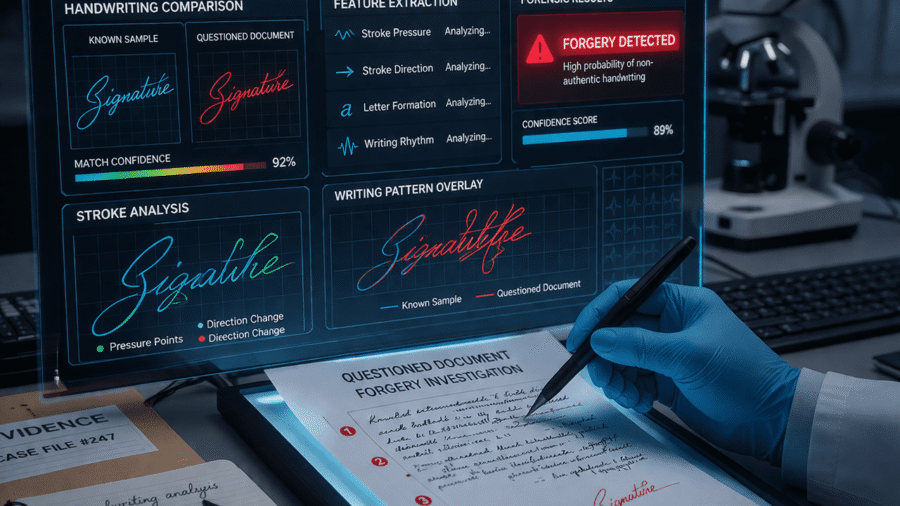
AI handwriting analysis refers to the use of machine learning algorithms and computer vision techniques to examine and compare handwriting samples. In simple terms, it automates the process of identifying writing patterns and detecting inconsistencies.

Furthermore, these systems are trained on large datasets, enabling them to recognize subtle differences that may not be easily visible to the human eye.

Role in Questioned Document Examination

Questioned document examination involves verifying the authenticity of documents such as contracts, wills, signatures, and anonymous notes. In this context, AI plays a crucial role by providing objective and data-driven results.

For instance, AI tools can:

  • Compare handwriting samples instantly
  • Detect forged signatures
  • Analyze writing speed and pressure patterns
  • Identify disguised or altered writing

Therefore, AI significantly improves the reliability of forensic conclusions.

Key Technologies Behind AI Handwriting Analysis

Machine Learning Algorithms

First of all, machine learning models are trained to recognize handwriting features such as stroke patterns and letter formation. These models continuously improve as more data is processed.

Computer Vision

Next, computer vision enables systems to analyze images of handwritten text. It detects shapes, spacing, and alignment with high precision.

Pattern Recognition

Additionally, AI identifies recurring patterns in handwriting. As a result, it becomes easier to distinguish between genuine and forged writing.

Neural Networks

Finally, deep learning models, especially neural networks, simulate human brain functions to analyze complex handwriting traits.

Advantages of AI in Handwriting Analysis

AI offers several benefits in forensic document examination:

  • Higher accuracy: Reduces human error
  • Speed: Processes large datasets quickly
  • Consistency: Provides standardized results
  • Scalability: Handles multiple cases efficiently

Moreover, AI can work alongside human experts, enhancing decision-making rather than replacing it.

Challenges and Limitations

Despite its advantages, AI handwriting analysis faces certain challenges:

Data Quality

On one hand, AI systems require high-quality datasets for training. Poor data can affect accuracy.

Variability in Handwriting

On the other hand, natural variations in handwriting can make analysis complex.

Ethical Concerns

Additionally, issues related to data privacy and misuse of AI must be addressed.

Legal Acceptance

Furthermore, courts may require validation before accepting AI-generated results as evidence.

Applications in Real-World Investigations

AI handwriting analysis is widely used in various fields:

  • Criminal investigations
  • Fraud detection
  • Banking and financial verification
  • Historical document authentication

For example, it helps detect forged signatures in financial transactions and verify legal documents.

Future of AI in Questioned Documents

Looking ahead, AI is expected to play an even bigger role in forensic science. Innovations such as real-time handwriting verification and integration with biometric systems are on the rise.

Consequently, the combination of AI and forensic expertise will lead to more accurate and efficient investigations.

Conclusion

To sum up, AI handwriting analysis is revolutionizing questioned document examination. Combining advanced algorithms with forensic expertise enhances accuracy, speed, and reliability.

Ultimately, as technology continues to evolve, AI will become a vital tool for detecting forgery and ensuring document authenticity.
ChatGPT Image Mar 26, 2026, 11_28_39 AM

The Howard Hughes Will Forgery: A Landmark Case in Handwriting Forensics

Introduction

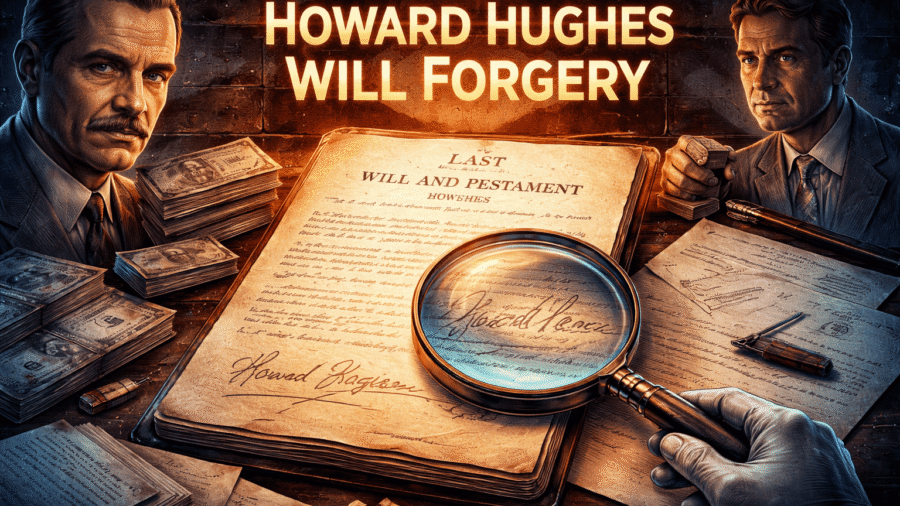
The Howard Hughes will forgery case is still one of the most interesting examples of forensic document examination in modern history. Following the death of billionaire Howard Hughes in 1976, a mysterious handwritten will surfaced, sparking controversy and legal battles over his vast fortune.

Therefore, this case became a landmark in forensic science, demonstrating how handwriting analysis and document examination can uncover fraud. The so-called “Mormon Will” not only captured public attention but also highlighted the importance of scientific methods in verifying questioned documents.

Background of the Case

Howard Hughes was a reclusive billionaire known for his business empire and eccentric lifestyle. After his death, confusion surrounded the distribution of his estate because no clear will had been officially recorded.

However, shortly after his death, a handwritten document was discovered at the Church of Jesus Christ of Latter-day Saints’ headquarters. This document claimed to be Hughes’ final will.

Most notably, the will included surprising provisions, with a significant portion of Hughes’ fortune left to a gas station owner named Melvin Dummar. As a result, the case quickly gained national attention and raised serious questions about its authenticity.

The Suspicious Will

The alleged will appeared simple and informal, lacking the structure expected from a billionaire’s legal document. In addition, several unusual aspects raised suspicion:

  • The document lacked proper legal formatting
  • It appeared suddenly without a clear origin
  • The handwriting seemed inconsistent with known samples
  • Witness credibility was questionable

Therefore, experts were called in to conduct a detailed forensic document examination.

Role of Handwriting Analysis

Handwriting analysis played a crucial role in determining whether the document was genuine. In forensic document examination, experts compare questioned writing with verified samples to identify similarities and differences.

Key Factors Examined

  • Letter formation and style
  • Spacing between words and lines
  • Slant and alignment
  • Writing pressure and stroke patterns

By analyzing these elements, forensic experts concluded that the handwriting on the will did not match authentic samples of Hughes’ writing.

Signature Analysis

The signature on the document was also carefully examined. However, inconsistencies in stroke order and fluency suggested that it was not naturally written.

As a result, experts determined that the signature was likely forged rather than genuine.

Investigation and Court Proceedings

As the case progressed, forensic evidence became central to the legal proceedings. Moreover, investigators examined not only the handwriting but also the circumstances surrounding the document’s discovery.

Melvin Dummar claimed that Hughes had personally given him the will. However, his story contained inconsistencies, which weakened his credibility.

Consequently, the court relied heavily on forensic analysis and expert testimony to evaluate the authenticity of the document.

Final Verdict

After a thorough examination, the court ruled that the will was a forgery. Therefore, the document was declared invalid, and the claims made under it were rejected.

The estate of Howard Hughes was distributed according to legal procedures rather than the forged will.

Ultimately, the case reinforced the importance of forensic document examination in resolving disputes involving questioned documents.

Importance of the Case in Forensic Science

The Howard Hughes will forgery case had a lasting impact on the field of forensic science. In particular, it demonstrated how handwriting analysis can provide reliable evidence in legal disputes.

Key Lessons

  • Forensic document examination is essential in verifying authenticity
  • Handwriting analysis can detect even sophisticated forgeries
  • Legal systems increasingly rely on scientific evidence
  • Questioned documents must be thoroughly investigated

Furthermore, the case highlighted the need for proper documentation and secure handling of legal documents.

Challenges in Forgery Detection

Despite its success, the case also revealed challenges in detecting forged documents:

  • Skilled forgers can imitate writing styles
  • Limited authentic samples may complicate analysis
  • External factors can influence handwriting

Nevertheless, trained forensic experts can identify subtle inconsistencies that reveal the truth.

Conclusion

The Howard Hughes will forgery case stands as a landmark example of how forensic handwriting analysis can expose fraudulent documents. In conclusion, this case illustrates the critical role of questioned document examination in legal investigations.

Therefore, as document forgery continues to evolve, the importance of forensic science in detecting and preventing fraud remains stronger than ever.