
Introduction
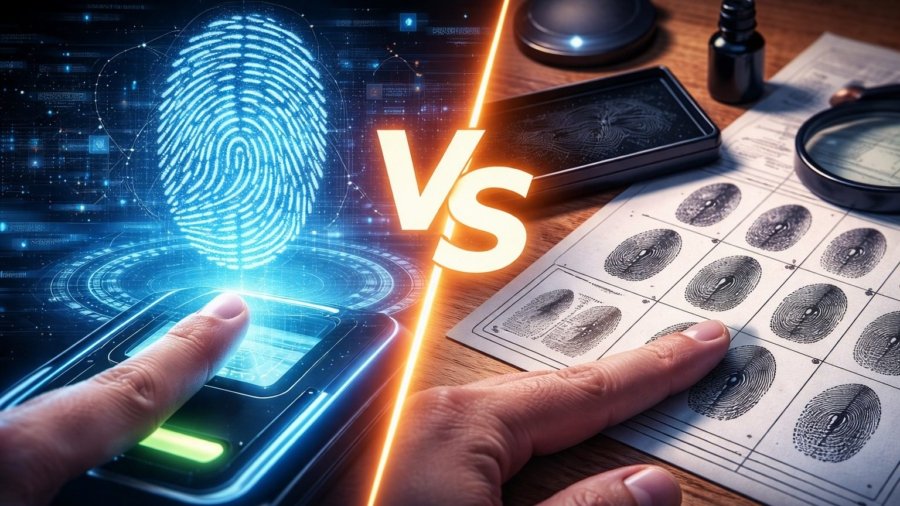
3D fingerprint scanning vs. traditional ink methods is a crucial comparison in modern forensic science. Fingerprint identification has been a cornerstone of forensic investigations for over a century. Traditionally, experts relied on ink-based fingerprint cards to record ridge patterns. However, with rapid technological advancements, 3D fingerprint scanning now offers improved accuracy, efficiency, and digital integration.
Today, fingerprints remain one of the most reliable methods of identification in criminal investigations, border security, and authentication systems. Therefore, understanding the difference between these two techniques is essential for forensic professionals and organizations.
Traditional Ink Fingerprinting in Forensic Science
The traditional ink fingerprinting method emerged in the late 19th century. It gained widespread acceptance after the classification system was introduced by Sir Edward Henry. As a result, fingerprint bureaus were established worldwide.
Even today, law enforcement agencies continue to use this method due to its simplicity and legal acceptance.
How Traditional Ink Fingerprinting Works
The process involves:
- Applying ink to the fingertip
- Rolling the finger onto a fingerprint card
- Preserving the print for analysis
After collection, investigators either examine prints manually or digitize them for systems like the Automated Fingerprint Identification System (AFIS).
Advantages of Traditional Ink Fingerprinting
Traditional ink fingerprinting offers several benefits:
- ✔ Cost-effective and affordable
- ✔ Easy to use in remote locations
- ✔ No advanced equipment required
- ✔ Widely accepted in courts
Therefore, it remains relevant, especially in low-resource environments.
Limitations of Ink Fingerprint Methods
However, this method has notable drawbacks:
- ❌ Smudging and distortion risks
- ❌ Time-consuming process
- ❌ Requires physical storage
- ❌ Hygiene concerns with shared ink
Consequently, the accuracy often depends on the examiner’s skill.
What’s 3D Fingerprint Scanning?
In contrast, 3D fingerprint scanning captures the three-dimensional structure of fingerprint ridges instead of flat images. This technology records:
- Ridge depth
- Pore structure
- Subsurface features
As a result, it provides far more detailed and reliable data.
How 3D Fingerprint Scanning Works
3D scanners use advanced technologies such as the following:
- Optical sensors
- Ultrasonic imaging
- Capacitive sensing
- Structured light
These systems project waves or light onto the finger and generate a 3D digital model. Unlike ink methods, they capture both surface and subsurface details.
Key Differences Between 3D Fingerprint Scanning and Ink Methods
1. Accuracy and Detail
3D fingerprint scanning captures deeper structural details, making it significantly more accurate than ink-based methods.
2. Speed and Efficiency
Ink methods require manual effort and drying time. In contrast, 3D scanners capture data instantly, making them ideal for airports and border security.
3. Digital Integration
Ink prints require physical storage or later digitisation. However, 3D scanning directly integrates with digital databases like AFIS, improving efficiency.
4. Hygiene and User Experience
Ink methods can be messy and unhygienic. On the other hand, 3D scanners offer a clean and contactless experience.
Forensic Implications of 3D Fingerprint Scanning
In forensic investigations, precision is critical. Since crime scene prints are often partial, 3D scanning helps analysts do the following:
- Improve matching accuracy
- Reduce human error
- Speed up investigations
Additionally, automated algorithms enhance objectivity in analysis.
Security Considerations
Although 3D fingerprint scanning improves security, challenges still exist. For example, spoofing using fake fingerprints remains possible.
However, advanced scanners detect the following:
- Blood flow
- Skin elasticity
Therefore, they offer stronger protection compared to traditional methods.
Cost and Accessibility
- Ink Fingerprinting: Low cost, widely accessible
- 3D Scanning: High initial investment but long-term efficiency
Thus, organizations must balance cost with performance needs.
Future of Fingerprint Identification
The future of 3D fingerprint scanning vs traditional ink methods clearly leans toward digital transformation. Emerging integrations include:
- Artificial Intelligence (AI)
- Cloud-based databases
- Blockchain security
- Multimodal biometrics
Ultimately, 3D fingerprint scanning is expected to become the global standard.
Conclusion
In conclusion, both methods have their place in forensic science.
Traditional ink fingerprinting offers affordability and legal reliability. However, 3D fingerprint scanning provides superior accuracy, speed, hygiene, and digital integration.
Therefore, while ink methods remain useful in certain contexts, the future of biometric identification is undoubtedly digital.
