
Introduction
Types of forgery in forensic document examination play a crucial role in identifying document fraud. Forgery is one of the most common crimes investigated in forensic science. In simple terms, forgery involves creating, altering, or copying a document with the intent to deceive.
Today, forgery cases frequently involve legal documents, financial transactions, contracts, and identity papers. Therefore, understanding the different types of forgery is essential for investigators, legal professionals, and forensic experts.
What is Forgery in the Forensic Document Examination?
In forensic science, forgery refers to any attempt to falsify handwriting, signatures, or documents. Experts in forensic document examination analyze:
- Handwriting characteristics
- Signature patterns
- Ink and paper composition
- Writing instruments
As a result, they can determine whether a document is genuine or forged.
Main Types of Forgery in Forensic Document Examination
1. Simple Forgery (Freehand Forgery)
Simple forgery, also known as freehand forgery, occurs when a person reproduces someone else’s handwriting from memory.
Since the forger does not copy directly from the original, the writing usually shows noticeable differences.
Key Characteristics:
- Irregular letter shapes
- Poor spacing and proportions
- Lack of consistency
Therefore, this type of forgery is relatively easy to detect. 2. Simulated Forgery
Simulated forgery involves carefully copying a signature or handwriting while observing the original.
Although it may appear accurate at first glance, detailed examination reveals flaws.
Key Characteristics:
- Slow and hesitant strokes
- Pen lifts and tremors
- Unnatural writing rhythm
Consequently, forensic experts can identify signs of imitation.
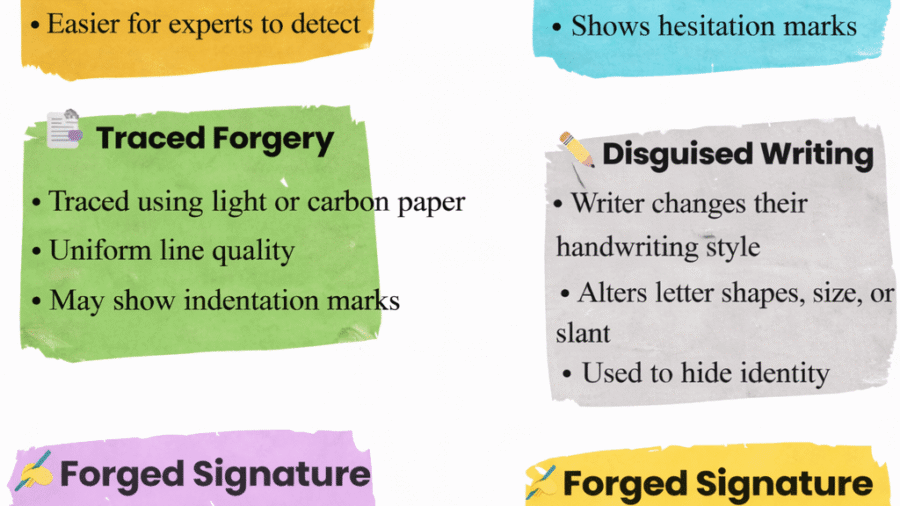
3. Traced Forgery
Traced forgery occurs when a person traces original writing using tools like:
- Carbon paper
- Light boxes
- Transparent sheets
This method produces a close visual copy, but it lacks natural writing features.
Key Characteristics:
- Uniform line quality
- Tremors in strokes
- Indentation marks on paper
As a result, traced forgeries can be detected using specialized forensic techniques.
4. Disguised Writing
Disguised writing is different from other types of forgery. In this case, a person alters their handwriting to hide their identity.
For example, they may change the following:
- Letter size
- Writing slant
- Spacing
- Writing speed
However, it is extremely difficult to eliminate natural handwriting habits. Therefore, experts can still identify the writer.
5. Forged Signature (Signature Forgery)
Signature forgery is one of the most common forms of document fraud. It involves signing another person’s name without authorisation.
This type is frequently seen in:
- Cheques
- Contracts
- Legal agreements
Key Characteristics:
- Variation in pen pressure
- Incorrect stroke sequence
- Lack of natural flow
Consequently, forensic examiners can detect forged signatures through detailed analysis.
Importance of Identifying Types of Forgery
Understanding the types of forgery in forensic document examination helps in:
- Detecting fraud and criminal activity
- Supporting legal investigations
- Providing expert evidence in court
- Preventing financial and identity crimes
Therefore, forensic document examination is essential in modern justice systems.
Conclusion
In conclusion, forgery remains a major challenge in document-related crimes. The primary types include:
- Simple (freehand) forgery
- Simulated forgery
- Traced forgery
- Disguised writing
- Signature forgery
Each type has unique characteristics. However, forensic experts use scientific methods to detect even the most sophisticated forgeries.
Ultimately, forensic document examination plays a vital role in ensuring authenticity, preventing fraud, and supporting justice.
